About Meliphaga notata (Gould, 1867)
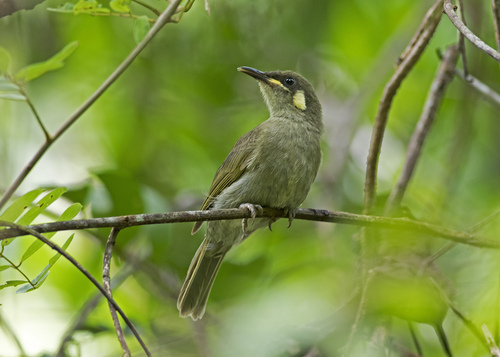
The yellow-spotted honeyeater, scientifically named Meliphaga notata (Gould, 1867), has distinct physical characteristics. Its upper body is olive-brown, while its underparts are olive-gray, with brighter yellow patches on the head. The bird's legs, feet, eyes, and beak are all brown. It measures 16 to 20 cm (6.3 to 7.9 in) in total length. Male yellow-spotted honeyeaters weigh between 24 and 29.5 grams, with an average mass of 27 g. Females weigh 23.5 to 30 g, with an average mass of 25.9 g. For the nominate subspecies Meliphaga notata notata, average wingspan ranges from 8.6 to 9.1 cm (3.4 to 3.6 in) for males and 7.9 to 8.3 cm (3.1 to 3.3 in) for females. For the subspecies Meliphaga notata mixta, average wingspan ranges from 8.3 to 8.7 cm (3.3 to 3.4 in) for males and 7.7 to 8.1 cm (3.0 to 3.2 in) for females. This species is primarily found in tropical rainforests of extreme northeastern Australia, North Queensland, located between Mackay and the northern Cape York Peninsula. A 1901 record also notes it inhabiting New Guinea. Yellow-spotted honeyeaters most commonly live at elevations of 200 metres (660 ft) or higher. They have been observed as high as 1,200 m (3,900 ft) above sea level, though they are rarely seen above 500 m (1,600 ft). While they typically reside in forests, they will visit suburbs that have enough tree cover, and have even been spotted in some cities that use local native plants for landscaping. The species occupies both open forests and forests with a shrubby understory, and it co-exists alongside the graceful honeyeater.