About Meliphaga lewinii (Swainson, 1837)
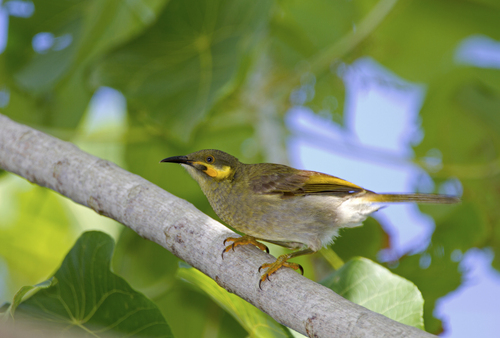
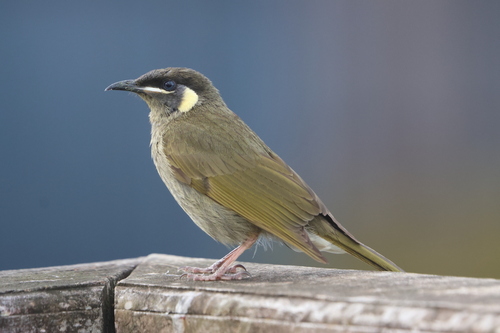
Lewin's honeyeater, Meliphaga lewinii, is a small to medium-sized bird, measuring 19–22 cm (7.5–8.7 in) in length and weighing 27–49 g. Its average wingspan ranges from 8.4–10.6 cm (3.3 to 4.2 in), and its bill is 2.0–2.7 cm long. It has dark greenish-grey plumage and a creamy yellow gape, the fleshy corners of the mouth. It has large, yellowish, crescent-shaped ear patches; these ear patches distinguish it from most other honeyeaters, except for two similar smaller species found in tropical Queensland. When in flight, pale yellow edges along its flight feathers are visible. The Lewin's honeyeater has a black bill and a blue-grey eye. Adult males and females look very similar. Young Lewin's honeyeaters resemble adults, but have brown eyes instead of blue-grey. This species produces loud, machine-gun-like rattling calls that can be heard over long distances, and their call often reveals their presence even when the bird is not seen. Body size, vocalization, and the shape and size of the ear patch help distinguish it from the similar Graceful Honeyeater and Yellow-spotted Honeyeater found in tropical Queensland. Lewin's honeyeater is native to the wetter regions of eastern Australia, ranging from northern Queensland down to central Victoria. It occurs in both rainforest and wet sclerophyll forest, and regularly wanders into more open woodland habitats. It is a common bird in these areas, where its call is frequently heard. It is mostly a sedentary species that remains in the same area year-round, though some populations do perform altitudinal migration, moving to lower elevations during the cooler winter months.