About Melilotus albus Medik.
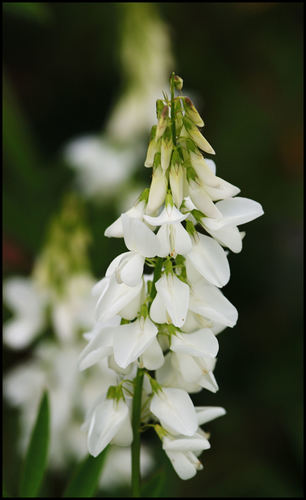
Melilotus albus Medik., commonly called white sweetclover, is an annual or biennial legume that can grow up to 2.5 meters (8 feet 2 inches) tall. Its light green stems are round or slightly furrowed on all sides, smooth, and often branched. Alternate, trifoliate leaves measure 1/2 to 2 inches long, are sparsely distributed along stems, and follow an alternate arrangement. Upper stems end in narrow hanging racemes of white flowers that are 2 to 6 inches long. Each individual flower is roughly 1⁄3 inch (8.5 mm) long, with 5 white petals and a light green 5-toothed calyx. Flowers are small, soft, tubular at the base and widen toward the outer edges; their wing and keel petals are approximately equal in length. Ovoid seedpods are black to dark grey, smooth or slightly reticulated, and about 0.3 inches long (3 to 4 mm). Each pod typically holds one, and sometimes two, ovate to kidney-shaped yellow seeds. Plants usually flower and die in their second year of growth. Blossoming runs from early summer to fall, peaks in mid-summer, and lasts 1 to 2 months for a plant colony. This species has an extensive root system with deep taproots that give it resistance to summer drought, and its roots associate with nitrogen-fixing bacteria. White sweetclover is native to most of Asia, southern Europe (ranging from France and Spain to Kazakhstan and Myanmar), and northeastern Africa. It has been introduced from Eurasia to South Africa, North America, South America, New Zealand, Australia, Tasmania, and many parts of Europe outside its native range. In the United States, it is most common in the upper Midwest and Great Plains regions, including Kentucky, Nebraska, Tennessee and Wisconsin. It was brought to North America as early as 1664 as a forage crop, after which it spread from cultivation and thrives in waste places and roadsides. It occurs in every U.S. state and all but 2 Canadian provinces. It establishes in aspen woodlands and prairies across Canada and the contiguous 48 U.S. states, and in riparian communities in Alaska. Its early spread was likely helped by beekeepers and agriculturalists, because it serves as an important fodder crop and food source for honey bees; it was introduced to Alaska in 1913 as a potential forage and nitrogen-fixing crop. White sweetclover prefers full sun, slightly moist to dry conditions, and calcareous clay-loam or gravelly soil, but it is adapted to a very wide range of climatic conditions and will grow in almost all soil types. This includes soils with very low nutrient levels, and both fine and coarse-textured soils, though plant size varies significantly based on soil moisture and fertility. It tolerates pH levels between 5.0 and 8.0, is salt-tolerant, drought resistant, and winter-hardy. Its range extends as far north as Canada’s Yukon and Northwest Territories and Alaska in the United States, so it grows in habitats with extreme weather: annual rainfall can be below 170 mm in some locations and almost 4000 mm in others, and annual temperatures can drop as low as -3.3 degrees Celsius in inland Alaska. Its long taproots give it drought tolerance; it only needs adequate moisture for germination, and can grow fully under extremely dry conditions after germination. It grows poorly in acid soils, is shade-intolerant, and cannot survive prolonged flooding, but it is occasionally found on gravelly open river banks that experience periodic flooding, such as those in Southern Ontario, Canada. Habitats where it can be found include limestone glades, thinly wooded bluffs, prairies, weedy meadows, open disturbed sites, riparian areas, agronomic fields, pastures, roadsides, ditches, vacant lots, and waste lands. It often grows in areas with abundant soil moisture, such as southern California, and is found in early succession or on recently disturbed or bare sites. White sweetclover has high seed germination rates. Most germination and development takes place in spring, and temperatures below 59 degrees F are optimal for germination. White and yellow sweetclover are considered valuable honey plants, and their foliage and seeds are eaten by wildlife. They are often cultivated as livestock forage and as a cover crop. Melilotus albus has been promoted for use on saline dryland soils in Australia. It has also been used in herbal medicine. It contains dicoumarol, an anticoagulant, and has a high sugar content.