About Melierax canorus (Thunberg, 1799)
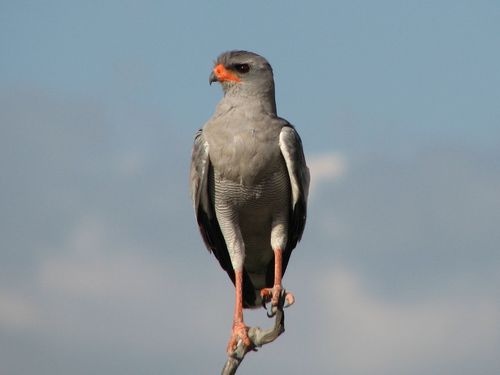
Melierax canorus, commonly called the pale chanting goshawk, is approximately 55 cm long with a 110 cm wingspan. Adult individuals have grey upperparts and a white rump. Their central tail feathers are black with white tips, while the outer tail feathers have alternating grey and white bars. The adult head and upper breast are pale grey, and the rest of the underparts have fine dark grey and white barring. Adult eyes are dark brown, while immature birds have pale yellow eyes. The bill is red at the base and dark grey at the tip, and the cere, facial skin, and long legs are all red. When in flight, adults have black primary flight feathers, very pale grey secondaries that appear white from a distance, and grey forewings. Immatures have brown upperparts, a white rump, and black bars on the tail. From below, the immature flight feathers and tail are white with black barring, the throat is white with dark streaks, and the rest of the underparts are rufous. The pale chanting goshawk is larger and paler than the closely related barred-rumped dark chanting goshawk, Melierax metabates. Both males and females vocalize during the breeding season. Their call is a tuneful whistling kleeu-kleeu-kleeu-ku-ku-ku, usually delivered from a tree-top perch. Pale chanting goshawks have a large range covering most of the drier regions of Southern Africa. They live in dry semi-desert areas with open ground and suitable perches for hunting. There is no evidence that this species migrates, though both short and long-distance movements are common. In the Karoo, a single pair or family group occupies a territory of between 4.4 and 8.6 km2, while around Windhoek one pair occupies between 5.4 and 6.7 km2. This raptor hunts predominantly from elevated perches such as trees and telephone poles, but also walks on the ground to pursue prey. It is an opportunistic predator that eats a wide variety of prey, including small mammals up to the size of Cape hares, lizards, birds, large insects, and carrion. It has also been recorded preying on hatchling tent tortoises and leopard tortoises, which are swallowed whole while their shells are still soft. There is some evidence of social hunting in breeding groups, but solitary hunting is the typical behavior. Pale chanting goshawks often associate with foraging honey badgers, and feed on organisms flushed out by the honey badger's feeding activity. This association increases the pale chanting goshawk's hunting opportunities and prey capture success, and does not reduce the honey badger's foraging efficiency.