About Melicope rubra (Lauterb. & K.Schum.) T.G.Hartley
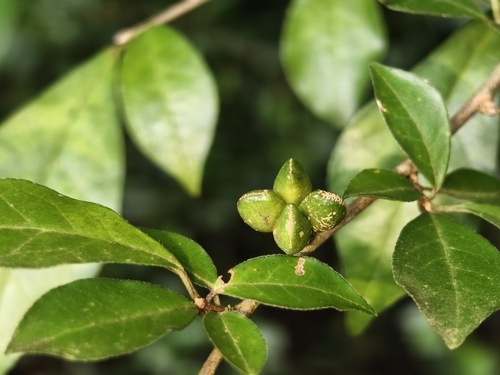
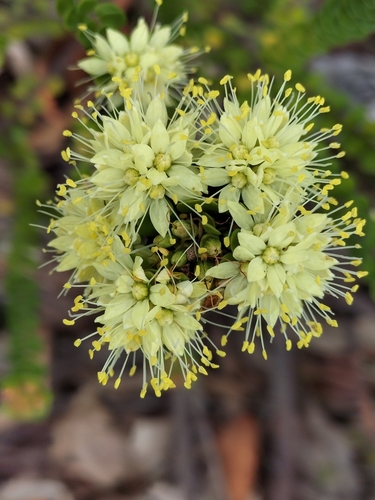
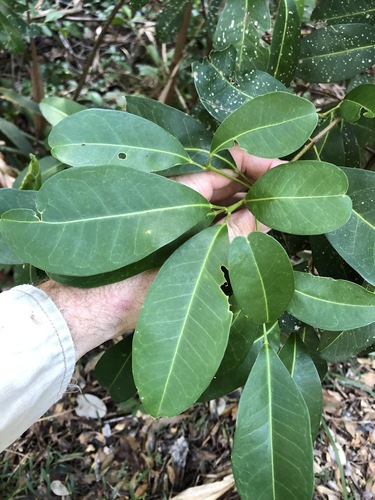
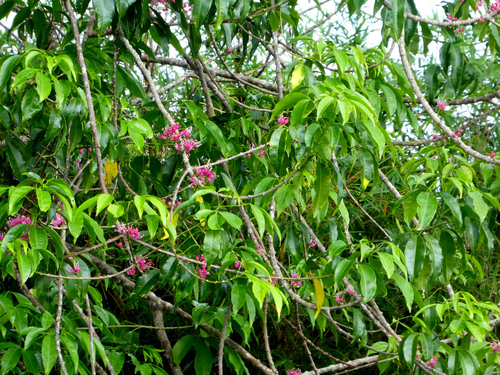
Melicope rubra is a plant that can grow as a 7-meter (23-foot) tall tree with a trunk diameter of about 30 cm (12 inches), but it flowers and fruits when it is still a shrub. Its leaves are arranged in opposite pairs, and are trifoliate, growing on a petiole 20 to 75 mm (0.79 to 2.95 inches) long. Leaflets are egg-shaped, 40 to 150 mm (1.6 to 5.9 inches) long and 15 to 45 mm (0.59 to 1.77 inches) wide; leaflets are either sessile or attached to a petiolule up to 10 mm (0.39 inches) long. Flowers are bisexual, arranged in 25 to 65 mm (0.98 to 2.56 inches) long panicles that grow on branches below the leaves. Sepals are roughly round to egg-shaped, 1.5 to 2.5 mm (0.059 to 0.098 inches) long and joined at the base. Petals are pink, 5 to 6 mm (0.20 to 0.24 inches) long, and each flower has four stamens. Flowering occurs from February to June. The fruit is made up of up to four follicles, 20 to 30 mm (0.79 to 1.18 inches) long, that are fused for at least half their length. This species is native to northeastern Queensland (where it occurs from near Rossville south to the area around Cardwell) and New Guinea (where it grows mostly along the central highland chain). It grows in and adjacent to rainforest, as well as in monsoon forest and wet sclerophyll forest. In Queensland, it occurs at altitudes from sea level to about 850 m (2,790 ft), and between 100 and 3,450 m (330 to 11,320 ft) in New Guinea. Multiple species of honeyeaters and lorikeets visit Melicope rubra flowers to feed on nectar, and Macleay's honeyeaters (Xanthotis macleayanus) eat its seeds. This tree is also a known host plant for the Ulysses butterfly (Papilio ulysses) and the Emperor Gum Moth (Opodiphthera eucalypti). Commonly called little evodia in cultivation, this species has become a popular choice for private gardens, public parks, and street plantings. This popularity stems from its small size, colorful flowers, and its ability to attract birds and butterflies. The Cairns Regional Council has planted approximately 95 individuals of this species around the city of Cairns.