About Melicope micrococca (F.Muell.) T.G.Hartley
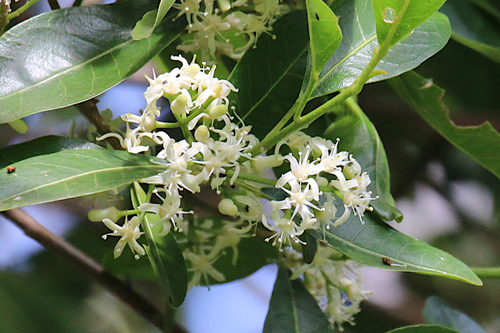
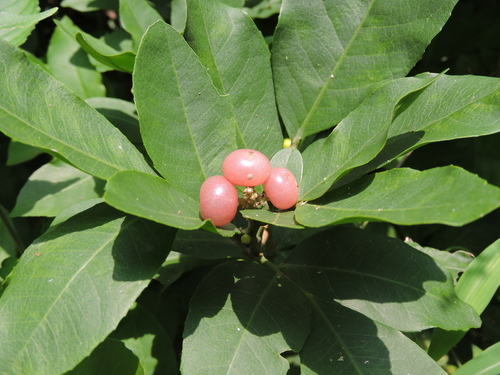
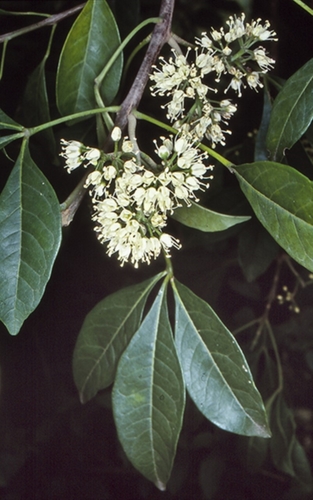
Melicope micrococca (F.Muell.) T.G.Hartley is a shrub or tree that typically reaches a height of 24–27 m (79–89 ft), with a diameter at breast height of up to 60 cm (24 in). It has a relatively smooth, pale brown trunk marked with some corky irregularities, and larger specimens develop flanges at the trunk base. Leaves are arranged in opposite pairs, and are trifoliate, borne on a petiole 10–95 mm (0.39–3.74 in) long. Leaflets are egg-shaped, with the narrower end oriented toward the base, measuring 25–130 mm (0.98–5.12 in) long and 12–50 mm (0.47–1.97 in) wide. Side leaflets are sessile, while the end leaflet grows on a petiolule 3–13 mm (0.12–0.51 in) long. Leaflets have visible oil dots, and their underside is a paler shade of green. Flowers are produced in panicles 25–100 mm (0.98–3.94 in) long, most often growing from leaf axils. All flowers are bisexual, with sepals 1–1.5 mm (0.039–0.059 in) long joined at the base, white petals 3.5–5 mm (0.14–0.20 in) long, and four stamens. Flowering takes place from November to February. After flowering, the fruit forms, consisting of up to four follicles 4–5 mm (0.16–0.20 in) long that are joined at the base. This species usually grows in rainforest, occurring between near sea level and an altitude of 1,050 m (3,440 ft). Its natural distribution ranges from near Seven Mile Beach, New South Wales (34° S) to Maryborough, Queensland (25° S). In its ecosystem, the fruit of Melicope micrococca is eaten by a range of bird species, including the brown cuckoo dove, crimson rosella, green catbird, and Lewin's honeyeater. This plant is also a host target for many insects, including butterflies belonging to the family Papilionidae.