About Melica uniflora Retz.
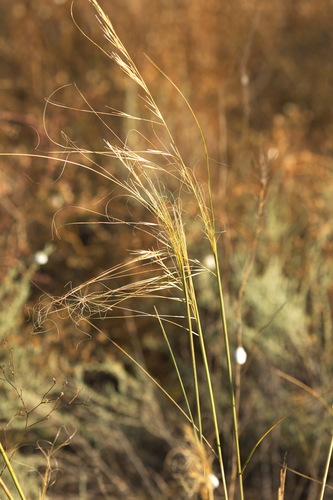
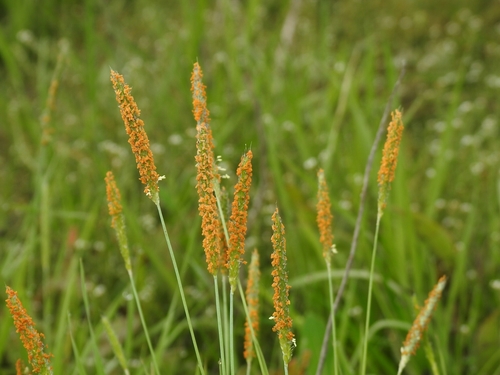
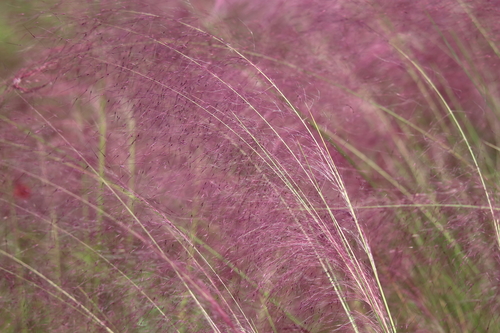
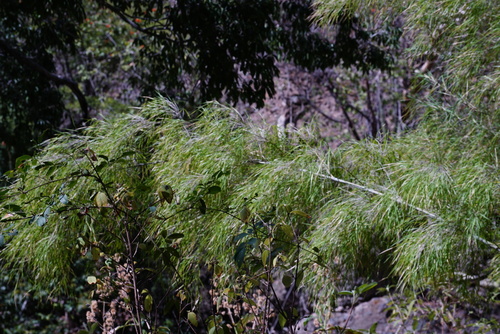
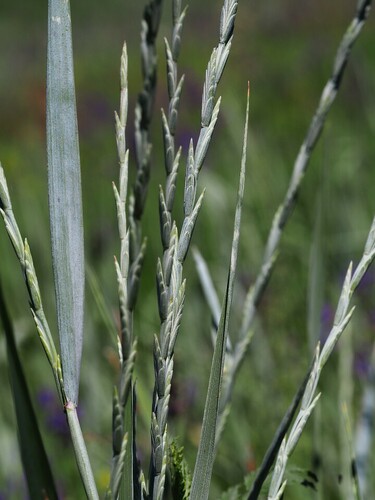
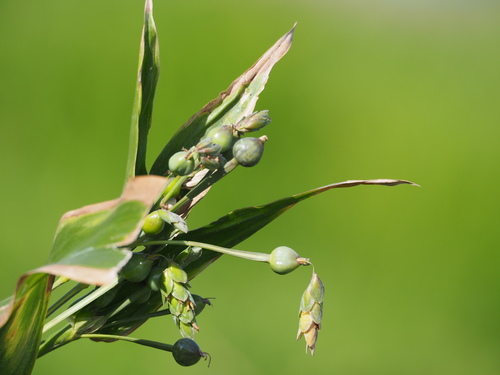
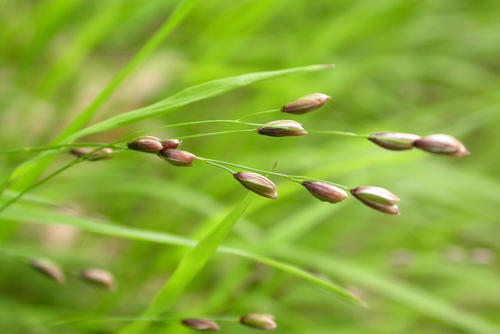
Melica uniflora Retz. has elongated rhizomes. Its culms grow 20–60 centimetres (7.9–23.6 in) long. Leaf blades are 5–20 centimetres (2.0–7.9 in) long and 3–7 millimetres (0.12–0.28 in) wide, with a pubescent, rough, scaberulous lower surface. It produces an open, effuse, elliptic panicle that is 6–22 centimetres (2.4–8.7 in) long and 1–12 centimetres (0.39–4.72 in) wide. Main panicle branches are scaberulous, and each lower branch holds 1–6 fertile spikelets. Spikelets are ascending, with fertile spikelets borne on pedicels. Pedicels are straight and 2–5 millimetres (0.079–0.197 in) long. The fertile floret lemma is chartaceous, elliptic, and 5–7 millimetres (0.20–0.28 in) long. Lower glumes are oblong and 3–6 millimetres (0.12–0.24 in) long. Flowers have 3 anthers that measure 1.5–2.3 millimetres (0.059–0.091 in) long. Fruits are ellipsoid, 3.5 millimetres (0.14 in) long, with an additional pericarp and a linear hilum. This species is distributed in the Asian countries Iran and Turkey; in Europe it occurs in the Balearic Islands, Faroe Islands, Finland, Iceland, Moldova, Portugal, Spain, and Sweden. It has also been recorded in Algeria, Morocco, and Tunisia. It grows on plains, and at up to 950 metres (3,120 ft) elevation in the Black Forest, and up to 1,200 metres (3,900 ft) elevation in the Alps. It occurs in hardwood forests near Fagus species, and can also grow in both dry and moist woodlands on either acidic or neutral soil. It is commonly found on sandy or rocky soils that are deep and loamy. In northern areas it grows on loamy soils, while in the south it prefers decalcified soils. It associates with vegetation of Fagatalia, found in lowland Fagetum and Carpinion communities, and rarely occurs in Quercion clusters. It flowers from May to July. Ants most commonly feed on its caryopsis. In cultivation, the form Melica uniflora f. albida has been awarded the Royal Horticultural Society's Award of Garden Merit.