About Melica picta K.Koch
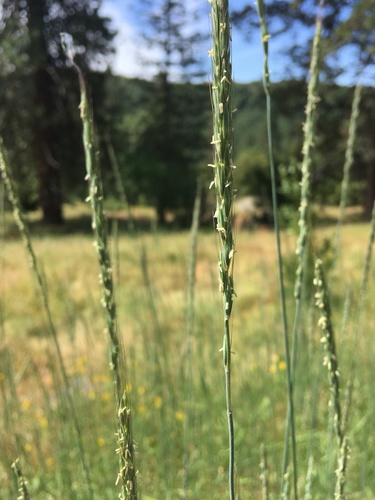
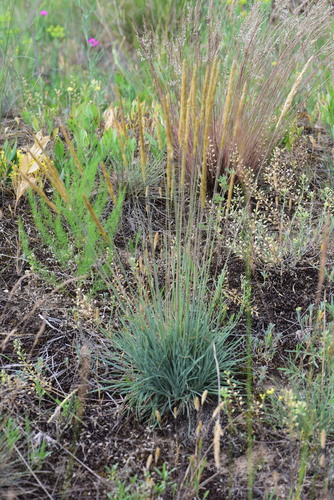
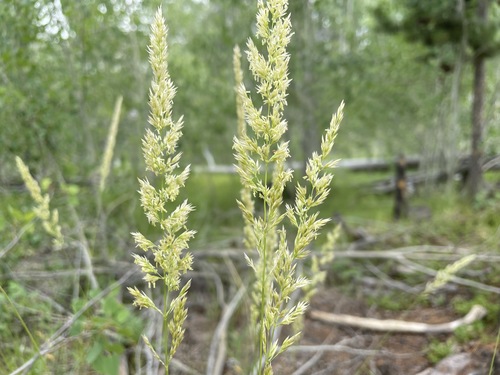
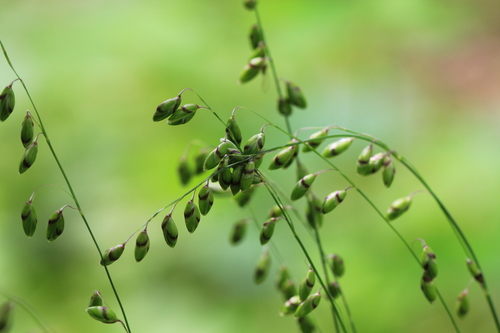
Melica picta K.Koch is a perennial, cespitose grass species with culms growing 40 to 80 centimetres (16 to 31 inches) long. Its leaf-sheaths are closed, tubular, and scabrous, and the eciliate membrane attached is 1 to 2.5 millimetres (0.039 to 0.098 inches) long. Leaf-blades are pilose, rough, hairy, with scabrous surfaces and margins, and end in an acuminate apex. Each leaf-blade measures 8 to 16 centimetres (3.1 to 6.3 inches) long and 2 to 5 millimetres (0.079 to 0.197 inches) wide. The species produces panicles that are linear, open, and secund, with a length of 6 to 12 centimetres (2.4 to 4.7 inches), and the panicles themselves are either 6 to 10 millimetres or 7 to 8 millimetres long. Panicle branches bear solitary, pediceled fertile spikelets. Spikelets are 8 to 10 millimetres (0.31 to 0.39 inches) long, oblong in shape, and hold fertile florets that are diminished at the apex. Both the lower and upper glumes are elliptic, 7 millimetres (0.28 inches) long, and can be either gray or red. Both glumes are keelless, 5-veined, and have an obtuse apex. The lemma is chartaceous, elliptic, 3 to 3.5 millimetres (0.12 to 0.14 inches) long, shiny, and keelless, with 3 veins. Like the glumes, the lemma apex is obtuse. The palea is 2-veined, lanceolated, and 5 to 5.5 millimetres (0.20 to 0.22 inches) in length. The species' flowers are fleshy, oblong, truncate, and grow adjacent to one another, with 3 anthers. Its fruits are caryopses with an adherent pericarp, measuring 2 millimetres (0.079 inches) long. In terms of ecology, Melica picta K.Koch is rare in hardwood and fir forests, and it is also uncommon on clay and loamy soils. Its flowering period is from May to June.