About Melibe colemani Gosliner & Pola, 2012
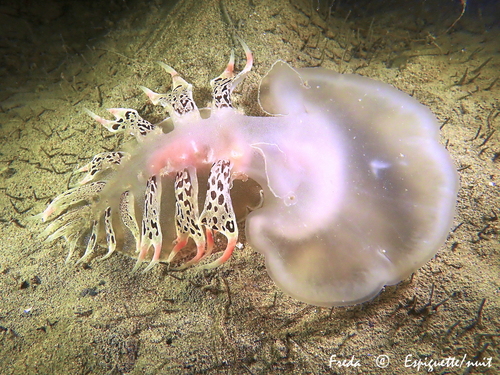
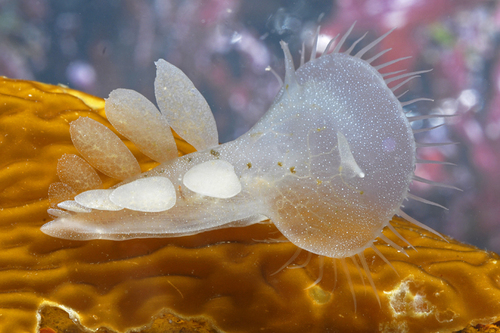
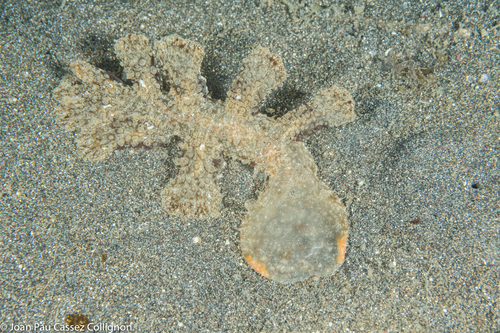
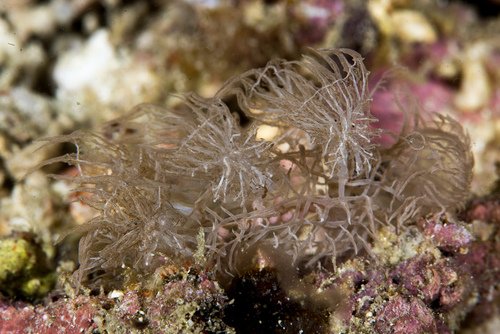
Externally, Melibe colemani resembles its close relatives Melibe bucephala and Melibe engeli. Like other nudibranchs, its cerata have elongated apical papillae, but its cerata are laterally flattened, unlike the cylindrical cerata of M. bucephala and M. engeli. The rhinoporal sheath of M. colemani is cylindrical, with a single papilla at its apex. This differs from the sail-shaped rhinoporal sheaths with multiple papillae found on the related species. The body of Melibe colemani is translucent, so its internal organs are visible to the naked eye. This sea slug's digestive glands appear as a network of whitish brown tubules. This network of digestive glands has been compared to a "pile of strings" or a "string of snot in the water". The tubule network acts as camouflage, helping the sea slug blend into its surroundings to look like a piece of sea floor debris, or like sponges, algae, or hydroids growing on the sea floor. The tubule network extends up the sea slug's back into the organs called cerata. At first glance, the anterior and posterior ends of the sea slug are hard to tell apart; the anterior end can only be identified by its net-shaped mouth. The maximum body length of Melibe colemani is approximately 60 millimetres, or 2.4 inches. Like other members of the family Tethydidae, this nudibranch has a net-like oral hood that acts as its mouth, and it swallows prey whole. Melibe colemani is thought to feed on corals of the genus Xenia, and individuals have been observed interacting with flatworms of the genus Waminoa. Dissection of stomach contents confirmed that this species eats shelled caenogastropods. Due to its unusual appearance and rarity, underwater photographers have nicknamed this nudibranch the "holy grail of nudibranchs". Melibe colemani is native to saltwater seas of Southeast Asia, across the Coral Triangle region. It was first sighted on Mabul Island, Malaysia. Additional sightings have been recorded near Komodo Island and Lembeh Island in Indonesia, and near Romblon in the Philippines. Romblon is specifically noted as a location where this nudibranch is particularly abundant. Melibe colemani lives in warm marine waters. One confirmed sighting occurred in water 10 metres, or 33 feet, deep with a temperature of 28 °C, or 82 °F. It is often found near coral rubble from corals of the genus Xenia, which is considered a possible food source for this sea slug. Observations of M. colemani from Mabul, Malaysia, note that the species occurs in association with the coral species Briareum.