About Meles meles (Linnaeus, 1758)
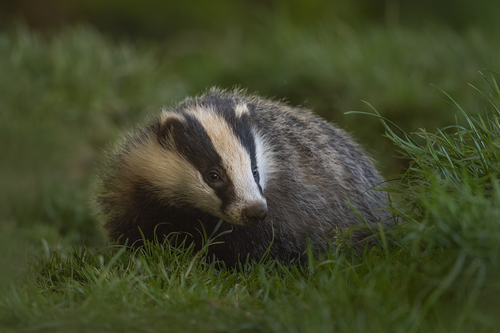
European badgers (Meles meles) are powerfully built animals with small heads, thick short necks, stocky wedge-shaped bodies and short tails. Their feet are short, and are either plantigrade or semi-digitigrade, with five toes on each foot. The limbs are short and massive, with bare lower foot surfaces. Their claws are strong, elongated, and have an obtuse end to facilitate digging; they are not retractable, and hind claws wear down with age. Old badgers sometimes have their hind claws almost completely worn away from constant use. Their snouts, used for digging and probing, are muscular and flexible. Their eyes are small, their ears are short and tipped with white, and whiskers grow on the snout and above the eyes. Male badgers (called boars) typically have broader heads, thicker necks and narrower tails than female badgers (called sows). Sows have sleeker bodies, narrower less domed heads and fluffier tails. Badgers have longer guts than red foxes, which reflects their omnivorous diet. The small intestine has an average length of 5.36 m (17.6 ft) and lacks a cecum. Both sexes have three pairs of nipples, though these are more developed in females. European badgers cannot flex their backs like martens, polecats and wolverines, nor can they stand fully erect like honey badgers, but they can move quickly at full gallop. Adult European badgers measure 25–30 cm (9.8–11.8 in) at the shoulder, 60–90 cm (24–35 in) in body length, 12–24 cm (4.7–9.4 in) in tail length, 7.5–13 cm (3.0–5.1 in) in hind foot length and 3.5–7 cm (1.4–2.8 in) in ear height. Males (boars) slightly exceed females (sows) in these measurements, but can weigh considerably more. Their weight varies seasonally: it increases from spring to autumn, peaking just before winter. During summer, European badgers commonly weigh 7–13 kg (15–29 lb), and weigh 15–17 kg (33–37 lb) in autumn. The average weight of adults in the Białowieża Forest was 10.2 kg (22 lb) in spring, but up to 19 kg (42 lb) in autumn, which is 46% higher than the spring low mass. In Woodchester Park, England, adults weighed an average of 7.9 kg (17 lb) in spring and an average of 9.5 kg (21 lb) in fall. In Doñana National Park, the average weight of adult badgers is reported as 6 to 7.95 kg (13.2 to 17.5 lb), which may align with Bergmann's rule that its size decreases in relatively warmer climates. Sows can reach a top autumn weight of around 17.2 kg (38 lb), while exceptionally large boars have been recorded in autumn. The heaviest verified specimen weighed 27.2 kg (60 lb), though unverified reports suggest weights of up to 30.8 kg (68 lb) and even 34 kg (75 lb); if the latter is correct, this would make the European badger the heaviest terrestrial mustelid. If average weights are considered, the European badger ranks as the second largest terrestrial mustelid, behind only the wolverine. Although European badgers have an acute sense of smell, their eyesight is monochromatic, which has been demonstrated by their lack of reaction to red lanterns. Only moving objects attract their attention. Their hearing is no better than that of humans. The skulls of European badgers are quite massive and heavy, with an elongated shape. Their braincases are oval, while the front portion of the skull is elongated and narrow. Adults have prominent sagittal crests which can reach 15 mm in height in older males, and these crests are more strongly developed than those of honey badgers. Besides anchoring the jaw muscles, the thickness of the crests protects the skull from physical impact. Similar to martens, the dentition of European badgers is well-suited for their omnivorous diets. Their incisors are small and chisel-shaped, their canine teeth are prominent, and their carnassials are not overly specialised. Their molars are flattened and adapted for grinding. Their jaws are powerful enough to crush most bones; a provoked badger once bit down so heavily on a man's wrist that his hand had to be amputated. The dental formula is 3.1.3.1 / 3.1.4.2. Scent glands are present below the base of the tail and around the anus. The subcaudal gland produces a cream-coloured, musky-smelling fatty substance, while the anal glands secrete a stronger-smelling, yellowish-brown fluid. The European badger is native to most of Europe. It is found in Albania, Armenia, Austria, Belarus, Belgium, Bosnia and Herzegovina, Bulgaria, Crete, Croatia, Czechia, Denmark, Estonia, Finland, France, Georgia, Germany, Great Britain, Greece, Hungary, Ireland, Italy, Latvia, Lithuania, Luxembourg, North Macedonia, Moldova, Montenegro, the Netherlands, Norway, Poland, Portugal, Romania, Russia, Serbia, Slovakia, Slovenia, Spain, Sweden, Switzerland and Ukraine. The distributional boundary between the ranges of European badgers and Asian badgers is the Volga River, with the European species inhabiting the western bank. The boundary between the ranges of the European badger and Caucasian badger is in the North Caucasus. However, a clear boundary has not been defined, and the two species are sympatric in some regions, potentially forming a hybrid zone. European badgers are common in European Russia, where 30,000 individuals were recorded in 1990. They are abundant and increasing in number throughout their range, partly due to a reduction in rabies in Central Europe. In the UK, the badger population increased by 77% during the 1980s and 1990s. The badger population in Great Britain in 2012 is estimated to be 300,000. The European badger inhabits deciduous and mixed woodlands, clearings, spinneys, pastureland and scrub, including Mediterranean maquis shrubland. It has adapted to living in suburban areas and urban parks, though not to the same extent as red foxes. In mountainous regions, it can be found at altitudes of up to 2,000 m (6,600 ft). The estrus cycle in European badgers lasts four to six days and can occur throughout the year, although there is a peak in spring. Sexual maturity in boars is usually attained at the age of twelve to fifteen months, but this can range from nine months to two years. Males are normally fecund during January–May, with spermatogenesis declining in summer. Sows usually begin ovulating in their second year, though some exceptionally begin at nine months. European badgers can mate at any time of the year, though the main peak occurs in February–May, when mature sows are in postpartal estrus and young animals experience their first estrus. Matings occurring outside this period typically occur in sows that either failed to mate earlier in the year or matured slowly. Badgers are usually monogamous; boars typically mate with one female for life, whereas sows have been known to mate with more than one male. Mating lasts for fifteen to sixty minutes, though the pair may briefly copulate for a minute or two when the sow is not in estrus. There is a two to nine month delay before fertilized eggs implant into the wall of the uterus, though matings in December can result in immediate implantation. Ordinarily, implantation happens in December, with a gestation period lasting seven weeks. Cubs are usually born in mid-January to mid-March within underground chambers lined with bedding. In areas where the countryside is waterlogged, cubs may be born above ground in buildings. Typically, only dominant sows can breed, as they suppress the reproduction of subordinate females. The average litter consists of one to five cubs. Although many cubs are sired by resident males, up to 54% can be fathered by boars from different colonies. Dominant sows may kill the cubs of subordinates. Cubs are born pink, with greyish silvery fur and fused eyelids. Neonatal badgers average 12 cm (4.7 in) in body length and weigh 75 to 132 g (2.6 to 4.7 oz), with cubs from large litters being smaller. By three to five days of age, their claws become pigmented, and individual dark hairs begin to appear. Their eyes open at four to five weeks, and their milk teeth erupt around the same time. They emerge from their setts at eight weeks of age, and begin to be weaned at twelve weeks, though they may still suckle until they are four to five months old. Subordinate females assist the mother in guarding, feeding and grooming the cubs. Cubs fully develop their adult coats at six to nine weeks. In areas with medium to high badger populations, dispersal from the natal group is uncommon, though badgers may temporarily visit other colonies. Badgers can live for up to about fifteen years in the wild. Badger meat is eaten in some districts of the former Soviet Union, though in most cases it is discarded. Smoked hams made from badgers were once highly esteemed in England, Wales and Ireland. Some badger products have been used for medical purposes. Badger expert Ernest Neal, quoting from an 1810 edition of The Sporting Magazine, wrote: "The flesh, blood and grease of the badger are very useful for oils, ointments, salves and powders, for shortness of breath, the cough of the lungs, for the stone, sprained sinews, collachs etc. The skin being well dressed is very warm and comfortable for ancient people who are troubled with paralytic disorders." The hair of the European badger has been used for centuries for making sporrans and shaving brushes. Sporrans are traditionally worn as part of male Scottish highland dress. They form a bag or pocket made from a pelt, and a badger or other animal's mask may be used as a flap. The pelt was also formerly used for pistol furniture.