About Meles leucurus (Hodgson, 1847)
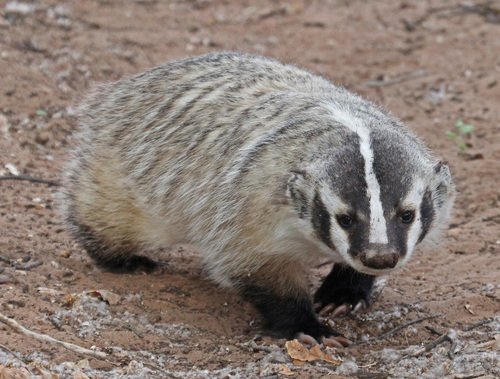
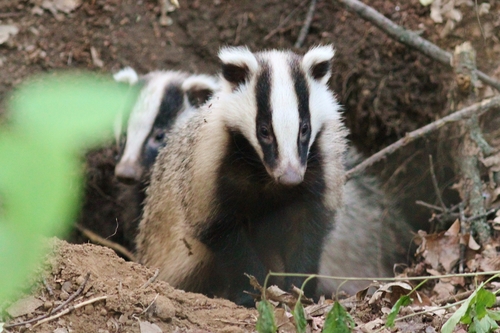
The Asian badger (Meles leucurus) is mostly lighter in color than the European badger, though some individual forms can be very similar in color to European badgers, or even darker, with smudged ocherous and brownish highlights. Its flanks are lighter than the middle of its back, and its facial stripes are usually brown rather than black. The facial stripes narrow behind the eyes and extend above the ears. The white areas of the Asian badger's head are usually duller and dirtier in color than the corresponding white areas on the head of the European badger. The light stripe that runs along the top of the head between the two facial stripes is relatively short and narrow. The Asian badger is generally smaller than the European badger and has relatively longer upper molars. Despite regional size variations, it appears to be the smallest of the three badger species in the genus Meles, with the largest-bodied populations located in Siberia. Its body mass typically ranges from 3.5 to 9 kg (7.7 to 19.8 lb), and its body length ranges from 50 to 70 cm (20 to 28 in). The average weight of three adult males from Sobaeksan National Park was 6 kg (13 lb). The Asian badger has a large range that includes southern Russia east of the Volga River and the Urals, Kazakhstan, Mongolia, China, and Korea. It occurs at high elevations up to 4,000 m (13,000 ft) in the Ural Mountains, the Tian Shan mountains, and the Tibetan Plateau. It prefers open deciduous woodland and adjacent pastureland, but also lives in coniferous and mixed woodlands, shrubland, and steppe. It sometimes enters suburban areas. The Asian badger is usually fossorial (burrowing), but occasionally climbs trees; this is confirmed by camera trap footage showing it climbing Korean oak (Quercus dentata) in South Korea.