About Meleagris ocellata Cuvier, 1820
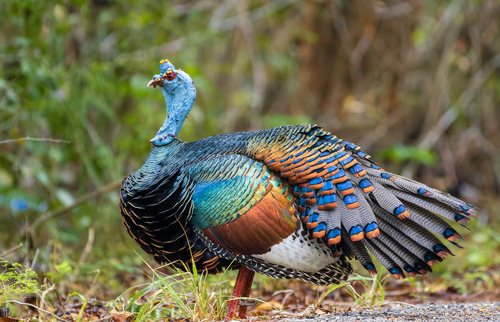
Both sexes of Meleagris ocellata (ocellated turkey) have body feathers that mix bronze and green iridescent color. While females can have duller overall plumage with more green, their breast feathers do not generally differ from males and cannot be used to tell the sexes apart. Neither sex has the "beard" that is typically found on common wild turkeys (North American wild turkeys).
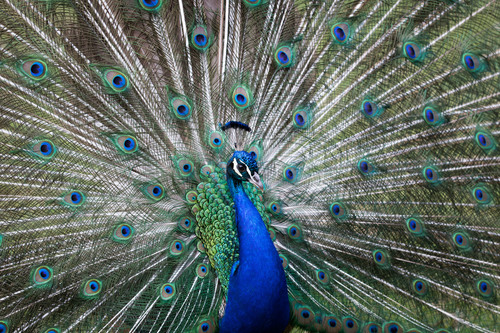
Tail feathers of both sexes are bluish-grey, with an eye-shaped blue-bronze spot near the feather tip, which ends in bright gold. These eye-shaped spots (called ocelli) on the tail give the ocellated turkey its name, and this patterning has been compared to the typical patterning seen on peafowl. The upper major secondary wing coverts are a rich iridescent copper. The primary and secondary wing feathers have similar barring to that of North American wild turkeys, but the secondaries have more white, especially along their edges.
Both sexes have blue heads with some orange or red nodules, which are more prominent on males. Males also have a fleshy blue crown covered with nodules, similar to those on the neck, located behind the snood. During breeding season, this crown swells and becomes brighter, with a more pronounced yellow-orange color. The eye is surrounded by a ring of bright red skin, which is most visible on males during breeding season. The legs are deep red, and are shorter and thinner than the legs of North American wild turkeys. Males over one year old have spurs on their legs that average 4 cm (1+1⁄2 in), and spurs longer than 6 cm (2.4 in) have been recorded. These spurs are much longer and thinner than the spurs of North American wild turkeys.
Ocellated turkeys are much smaller than any subspecies of North American wild turkey. Adult hens weigh about 4 kg (8.8 lb) before laying eggs, and 3 kg (6–7 pounds) for the rest of the year. Adult males weigh about 5–6 kg (11–13 lb) during breeding season.
Vocalizations of hen ocellated turkeys are similar to those of their North American relatives, but the male vocalization called a "gobble" is quite different in comparison. The gobble starts with several low-frequency "thumps", similar to the sound of a small gasoline engine starting. As the tempo of the thumps increases, the typical gobble is produced. Branton and Berryhill (2007) observed that the male ocellated turkey does not gobble in the same way that the common wild turkey does. Instead, the male's call is distinct, and includes six to seven bongo-like bass tones that quicken in both cadence and volume until a crescendo is reached. At this point the bird's head is fully erect, and it gives out a series of rather high-pitched but melodious chops. Ocellated turkeys typically start calling 20 to 25 minutes before sunrise, which is similar to the common wild turkey.
In terms of ecology, the species is thought to have declined due to land use changes and harvest levels higher than what is sustainable, from migrant workers and subsistence hunters living in the Yucatán Peninsula region of Central America. A 2011 study found that ocellated turkeys make up a substantial part of the diets of four prominent ethnic groups of the Yucatán Peninsula.