About Meleagris gallopavo Linnaeus, 1758
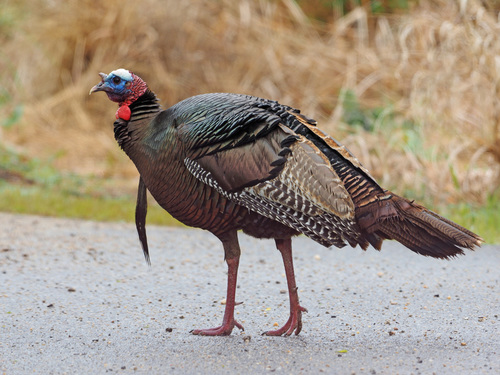
This species, Meleagris gallopavo Linnaeus, 1758, exhibits strong sexual dimorphism, with adult males (called toms or gobblers) substantially larger than adult females (called hens). Adult males normally weigh 5 to 11 kg (11 to 24 lb) and measure 100–125 cm (39–49 in) in length, while adult females typically weigh 2.5–5.4 kg (5.5–11.9 lb) and measure 76 to 95 cm (30 to 37 in) long. Data from two large studies gives an average adult male weight of 7.6 kg (17 lb) and an average adult female weight of 4.26 kg (9.4 lb). According to the National Wild Turkey Federation, the largest recorded adult male wild turkey weighed 16.85 kg (37.1 lb); records of tom turkeys weighing over 13.8 kg (30 lb) are uncommon but not rare. When considering both maximum and average weight, Meleagris gallopavo is among the heaviest flying birds in the world. It has the second-highest maximum average weight of any North American bird, after the trumpeter swan (Cygnus buccinator), though several other American birds have a higher average mass than wild turkeys, including the American white pelican (Pelecanus erythrorhynchos), the tundra swan (Cygnus columbianus columbianus), the endangered California condor (Gymnogyps californianus), and the whooping crane (Grus americana). As is typical for members of the galliform order, the wings of Meleagris gallopavo are relatively small, with a wingspan ranging from 1.25 to 1.44 m (4 ft 1 in to 4 ft 9 in) and a wing chord measuring only 20 to 21.4 cm (7.9 to 8.4 in). The bill is also relatively small, with an adult culmen length of 2 to 3.2 cm (0.79 to 1.26 in). The wild turkey's tarsus is quite long and sturdy, measuring from 9.7 to 19.1 cm (3.8 to 7.5 in), and the tail is relatively long, ranging from 24.5 to 50.5 cm (9.6 to 19.9 in). Fully-grown wild turkeys have long legs that range in color from reddish-yellow to grayish-green. Each foot has three front toes and a shorter, rear-facing toe; males have a spur behind each of their lower legs, which they use to spar with other males. Overall, body feathers are generally blackish and dark, and sometimes gray-brown, with a coppery sheen that becomes more complex in older males. Mature males have a large, featherless, reddish head and red throat, with red wattles on the throat and neck. The head has unique fleshy growths called caruncles, which may allow individual birds to be distinguished from one another. When toms become excited, a fleshy flap on the bill called a snood expands; the snood, wattles, and bare skin of the head and neck all turn red as blood flow to the head increases. Adult turkeys have tail feathers of uniform length, while juvenile turkeys have tail feathers of different lengths. Males have a long, dark, fan-shaped tail and glossy bronze wings, and their feathers have areas of red, purple, green, copper, bronze, and gold iridescence. The preen gland (uropygial gland) is larger in males than in females, and unlike most other birds, Meleagris gallopavo is colonized by the bacteria Corynebacterium uropygiale, whose function is currently unknown. Most males have at least one "beard", a tuft of coarse hair-like filaments called mesofiloplumes that grows from the center of the breast. Beards grow continuously throughout the turkey's lifespan; a one-year-old male has a beard up to 13 cm (5 in) long. Approximately 10% of females also have a beard, which is usually shorter and thinner than a male's beard. Female feathers are duller overall, in shades of brown and gray. Parasites can dull the coloration of both sexes, and in males, vivid coloration may act as a signal of good health. The primary wing feathers have white bars, and wild turkeys have approximately 5,000 to 6,000 feathers total. Juvenile males are called jakes; jakes differ from mature toms in that jakes have very short beards and tail fans with longer feathers in the middle, while a mature tom's tail fan has uniform-length feathers. Wild turkeys prefer hardwood and mixed conifer-hardwood forests with scattered open areas such as pastures, fields, orchards and seasonal marshes. They can adapt to almost any dense native plant community as long as sufficient coverage and openings are available, with open, mature forest featuring a mix of tree species being the preferred habitat. In the Northeast of North America, turkeys are most abundant in oak-hickory (Quercus-Carya) hardwood timber, and forests of red oak (Quercus rubra), beech (Fagus grandifolia), black cherry (Prunus serotina) and white ash (Fraxinus americana). In the Coastal Plain and Piedmont sections, the best turkey ranges have a mix of clearings, farms, and plantations, with preferred habitat located along principal rivers and in cypress (Taxodium distichum) and tupelo (Nyssa sylvatica) swamps. On the Appalachian Plateau and Cumberland Plateau, turkeys live in mixed oak and pine forests on southern and western slopes, as well as hickory forests with diverse understories. In Florida, wild turkeys occupy bald cypress and sweet gum (Liquidambar styraciflua) swamps in the southern part of the state, and Cliftonia (a heath) hardwood and oak forests in north-central Florida. The Lykes Fisheating Creek area of south Florida has up to 51% cypress, 12% hardwood hammocks, and 17% short grass glades with isolated live oak (Quercus virginiana), with nesting taking place in neighboring prairies. The original habitat in this region was mainly longleaf pine (Pinus palustris) with turkey oak (Quercus laevis) and slash pine (Pinus elliottii) "flatwoods", which are now mostly replaced by slash pine plantations. In California, wild turkeys live in a wide range of habitats. Acorns are a favorite food, along with wild oats (Avena barbata), which draws turkeys to open oak forest and oak savanna areas across the central parts of the state. They frequent lower-elevation oak woodlands of the Sierra Nevada foothills and Coast Ranges, and the central coast north through Mendocino County, which is primarily open conifer forest with various fern species growing in the understory. They can also be found in the conifer foothills and fern-heavy forested areas of the Klamath Mountains and Cascade Range in northern California. In San Diego County, turkeys tend to be found at least 30–50 miles inland, away from the coast at reasonably higher elevation; a healthy turkey population lives in the montane conifer woods and open oak forest habitats of the Cleveland National Forest, a region that borders the high desert and generally receives very little annual precipitation. Turkeys in these areas use dense thickets of manzanita (Arctostaphylos) that grow on arid hillsides for shelter and nesting sites, and can also be found on rocky, boulder-strewn chaparral foothills. At the beginning of the 20th century, the range and population size of wild turkeys dropped sharply due to overhunting and habitat loss. When Europeans first arrived in the New World, wild turkeys were found from the southeastern United States to Mexico. Turkeys were first domesticated by native peoples in Mexico, and were brought back to Europe during colonization. European settlers brought domesticated turkeys to the northern portions of North America during the 17th century. Over the next two centuries, habitat loss and market hunting were major factors in the decline of wild populations. Game managers estimate that the entire wild turkey population in the United States was as low as 30,000 by the late 1930s. By the 1940s, the species was almost completely extirpated from Canada, and had become restricted to isolated pockets in the United States; in the northeast, it was effectively limited to the Appalachians, only as far north as central Pennsylvania. Early reintroduction attempts used hand-reared birds, which failed completely because the birds could not survive in the wild, and many had become too strongly imprinted on humans to survive. Later, game officials implemented efforts to protect and encourage breeding of the remaining wild population. They allowed populations to grow, captured surplus birds with a projectile net, moved them to unoccupied suitable territory, and repeated the process. Over time, this included reintroduction to some western states where the species was not originally native. Evidence shows that wild turkeys thrive near farmland, which provides grain and berry-bearing shrubs at its edges. As wild turkey populations rebounded, hunting became legal in 49 U.S. states (excluding Alaska). In 1973, the total U.S. population was estimated at 1.3 million individuals, and current estimates place the entire wild turkey population at 7 million individuals. Since the 1980s, "trap and transfer" projects have also reintroduced wild turkeys to several Canadian provinces, often from populations across the border in the United States. As of 2018, these reintroductions appear to be very successful: wild turkeys have multiplied rapidly and flourished in areas far north of their original expected range, where Canadian scientists did not expect them to survive. 18th century attempts to introduce wild turkeys to Britain as a game bird were unsuccessful. George II is said to have kept a flock of several thousand in Richmond Park near London, but the birds were too easy for local poachers to steal, and conflicts with poachers became too dangerous for gamekeepers. Populations introduced or escaped in other parts of Britain and Ireland survived for varying periods but eventually died out, likely due to a combination of lack of winter feed and poaching. Small populations in the Czech Republic and Germany, probably descended from both farmed and wild stock, have been more successful. There are also sizeable wild populations of introduced wild turkeys in Hawaii and New Zealand. The Californian turkey (Meleagris californica), an extinct species that was native to California during the Pleistocene and early Holocene, became extinct roughly 10,000 years ago. The current wild turkey population in California originates from wild turkeys introduced to the region during the 1960s and 1970s from other areas by game officials. They multiplied after 2000, and had become a common sight in the East Bay by 2015.