About Melanotis hypoleucus Hartlaub, 1852
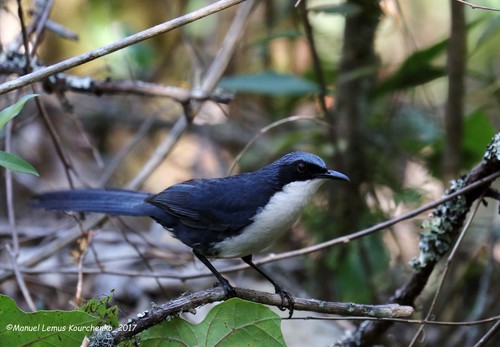
The blue-and-white mockingbird (scientific name Melanotis hypoleucus Hartlaub, 1852) measures 24.2 to 28 cm (9.5 to 11.0 in) in length. A sample of 20 specimens had an average mass of 68 g (2.4 oz). Adult blue-and-white mockingbirds have dull slate blue upperparts, with a slightly brighter shade on the crown. Their wings and tail are slaty black, and a prominent black "mask" runs from the lores past the eye. Their underparts are white, and darken to bluish or slate gray on the flanks and vent area. Juveniles follow a similar plumage pattern, but have dull slaty gray upperparts instead of blue. The blue-and-white mockingbird is a permanent resident ranging from Mexico south of the Isthmus of Tehuantepec, through Guatemala, to El Salvador and southern Honduras. It lives in a range of landscape types, including edges of humid evergreen forest, pine-oak forest, second growth, and both humid and semi-arid scrublands. Its elevation range is between 900 and 3,000 m (3,000 and 9,800 ft).