About Melanosuchus niger (Spix, 1825)
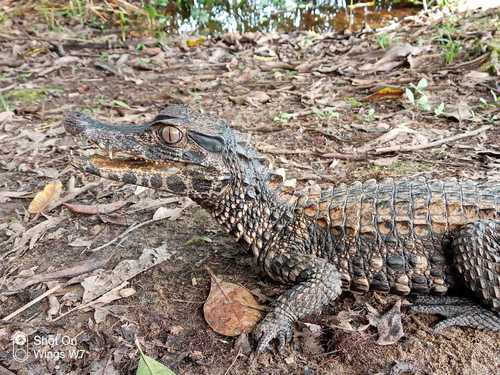
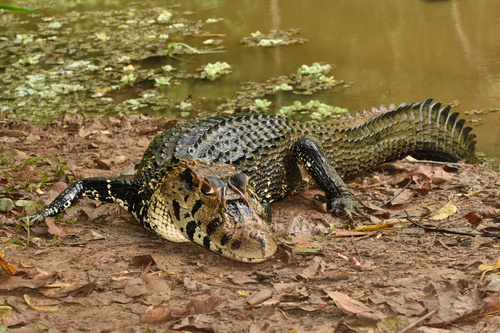
The black caiman (Melanosuchus niger) has dark, scaly skin. This dark coloration helps it camouflage during nocturnal hunts, and may also aid heat absorption for thermoregulation. The lower jaw has grey banding that turns brown in older individuals, and pale yellow or white bands cross the body flanks; these bands are much more prominent in juveniles, and fade only gradually as the caiman matures. Like other caimans, it has a bony ridge that extends from above the eyes down the snout. Its large, brown eyes fit its mostly nocturnal lifestyle. Nest-guarding mothers are bothered by blood-sucking flies that gather around their vulnerable eyes, turning the eyes bloodshot.
Black caimans differ structurally from other caiman species, especially in skull shape. Compared to other caimans, they have distinctly larger eyes, a relatively deep snout, and a much larger overall skull, matching the species' considerably larger body size. They are more robust than other crocodilians of similar length. Like other modern crocodilians, black caiman skull morphology varies by age and individual, and also differs by gender: adult males typically have much more massive skulls relative to their size than females of the same age. These differences give males a stronger bite force, and they likely hunt different, larger prey than females.
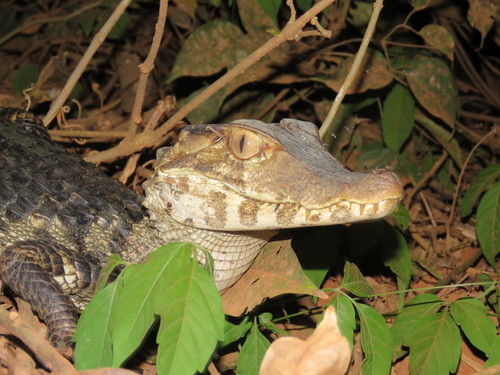
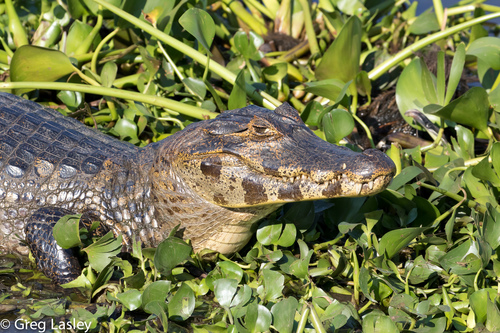
Young black caimans can be told apart from large spectacled caimans by their proportionally larger head, and their jaw colour: spectacled caimans have light-coloured jaws, while black caimans have dark jaws marked with three black spots. One recorded 3-metre (10 ft), 103-kilogram (227 lb) black caiman had a measured bite force of 4,310 N (970 lbf).
Black caimans mostly inhabit Amazonian regions, where they live in rivers, swamps, wetlands, and lakes. They can be found in Brazil, eastern Ecuador, eastern Peru, northern Bolivia, eastern French Guiana, and southern Guyana.
At the end of the dry season, female black caimans build a nest out of soil and vegetation, which measures about 1.5 m (4.9 ft) across. Females lay up to 65 eggs, most commonly between 30 and 60 eggs. Eggs are quite large, averaging 144 g (5.1 oz) in weight. Eggs hatch around six weeks after laying, at the start of the wet season, when newly flooded marshes provide ideal habitat for newly hatched juveniles. Reported hatching times range from 42 to 90 days after laying. When the mother leaves the nest to hunt, unguarded clutches are easily eaten by a wide range of animals, including mammals such as South American coatis (Nasua nasua) and large rodents, egg-eating snakes, and birds such as herons and vultures. Mother caimans occasionally catch and kill these nest predators.
As documented for other crocodilians, after hatching caimans often carry their young to a safe pool in their mouths; this behaviour led to the incorrect belief that caimans eat their young. Mothers will also help unhatched, chirping young break out of their leathery eggs by gently cracking the shells between their teeth. Mothers will attempt to care for their young for several months, but baby caimans are mostly independent, and most do not survive to maturity. After hatching, baby black caimans are even more frequently preyed on, by many of the same mid-sized predators that eat eggs, as well as by other crocodilians (including other black caimans), large snakes, and large carnivorous fish. Predation on juveniles is so common that black caimans rely on high numbers of young to ensure some survive to adulthood. Female black caimans reach sexual maturity at 20 years of age, and only breed once every 2 to 3 years. During the dry season, which overlaps with their breeding season, black caimans produce a call that closely resembles rumbling thunder to communicate with other individuals.