About Melanoptila glabrirostris P.L.Sclater, 1858
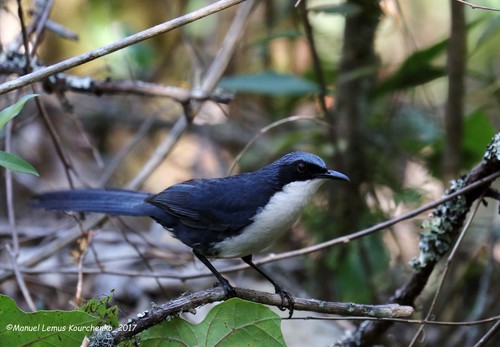
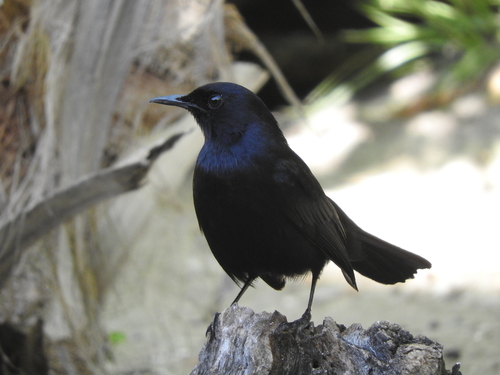
The black catbird (Melanoptila glabrirostris) measures 19–20.5 cm (7.5–8.1 in) in length and weighs 31.6–42 g (1.11–1.48 oz), making it the smallest species in the mimid family. It has short, rounded wings and a relatively long tail. Males and females look similar overall, though males typically weigh more. The species’ entire plumage is glossy black with an overall purplish sheen, but its rectrices, primary coverts, and secondary coverts have a greenish sheen, and its remiges are duller blackish-brown with reduced sheen. Females are less glossy than males, while juvenile black catbirds are brownish-gray with mottling on their underparts. The species has black legs. Its bill is black, shorter than the length of its head, with an overall straight culmen that curves downward toward the tip. Adults have dark reddish irises, while juveniles have gray irises. The black catbird is endemic to the Yucatán Peninsula. Its range extends south to the Mexican state of Campeche, northern Guatemala, and northern Belize, and it also lives on the offshore islands of Cozumel, Isla Mujeres, Ambergris Caye, Caye Caulker, Lighthouse Reef, and Glover's Reef. The species’ type specimen was reportedly collected in northwestern Honduras in 1855 or 1856, but it has not been recorded in Honduras since that time; it would have been rare there even if it did occur at the site. Some authors suggest the specimen may have been mislabeled, and actually originated from northwestern "British Honduras," the former name of Belize. There is also a single black catbird specimen collected from Brownsville, Texas in 1892. Though the specimen was collected by a reportedly reputable collector and accepted by the Texas State Records Committee, its origin remains controversial, and it has not been accepted as a valid record by the American Birding Association or the American Ornithologists' Union. This species occurs at low elevations in semi-arid to humid areas, in habitats ranging from scrubland and abandoned farmland to wood edge. It prefers areas with dense thickets, scrub, or understory, and is uncommon in taller forest where the vegetation under the canopy is more open. Though it is largely sedentary, it may make small localized seasonal movements, leaving the drier northern parts of the Yucatán Peninsula from late summer to early winter. No specific studies have been conducted on the black catbird's feeding ecology, but researchers think it is an omnivore, like its close relatives. It is confirmed to eat the fruits of Bursera simaruba and Ficus cotinifolia, two deciduous tree species native to the Neotropics.