About Melanoides tuberculata (O.F.Müller, 1774)
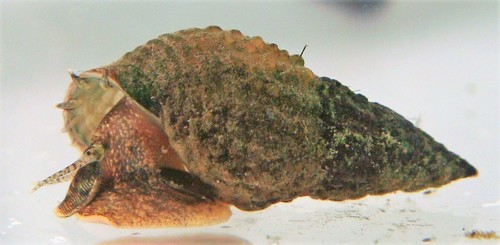
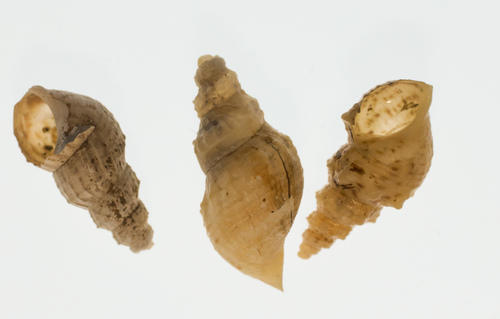
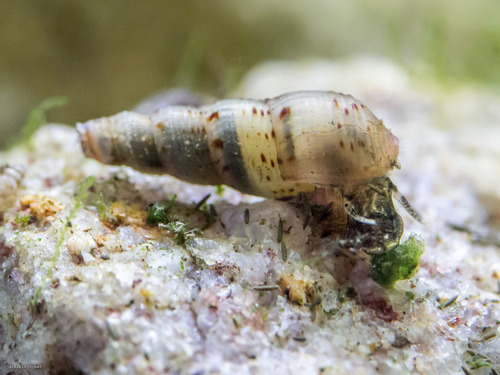
This species, Melanoides tuberculata, has an elongated, conical shell that is typically light brown with rust-colored spots, and it bears an operculum. In some locations including Israel, shells may be black or dark brown, a trait thought to help the snails conceal themselves against the basalt rocks of the Sea of Galilee (Kinnereth). Average shell length falls into two common size ranges: 20–27 millimetres (3⁄4–1+1⁄8 inches) or 30–36 millimetres (1+1⁄8–1+3⁄8 inches), while exceptional individual specimens can reach up to 80 millimetres (3+1⁄8 inches) long. Shells of this species have 10–15 whorls. There are two main competing hypotheses for this species' native range: one that it is native to subtropical and tropical Africa excluding West Africa, the Indo-Pacific region, South Asia, and the Arabian Peninsula; the other that it is native to northern Africa and southern Asia. Documented native-range countries in Africa include: Algeria, Burundi, The Democratic Republic of the Congo, Egypt, Eritrea, Ethiopia, Kenya, Libya, Malawi, Morocco, Mozambique, Namibia, Niger, South Africa (Eastern Cape Province, Free State, Gauteng, KwaZulu-Natal, Limpopo Province), Botswana, Eswatini, Senegal, Sudan, Tanzania, Tunisia, and Zimbabwe. Documented native-range locations in Asia include: Bangladesh, Cambodia, China, India (including the Andaman Islands), Israel, Japan, Taiwan, Laos, Peninsular Malaysia, Nepal, Saudi Arabia, Sri Lanka, Vietnam, and Thailand. A prehistoric occurrence of this species is recorded at Gobero in Niger, dating to 6200–5200 BCE. This species has a wide nonindigenous distribution that includes Cuba, the United States (established here since the 1930s), broader Latin America (present since the late 1960s), Brazil (established since 1967, with presence on Ilha Grande in Rio de Janeiro, southeastern Brazil since 2004), the Netherlands (present before 1990), New Zealand, Venezuela, Dominica, Trinidad, and other locations. It can also survive in artificially heated indoor habitats like aquaria and greenhouses, and has been recorded in similar biotopes or wild warm sites including a thermal brook in Slovakia, the Czech Republic, Germany, Great Britain, and Greece (documented before 2026). In the United States, this species became established outside its natural range largely through aquarium trade activities; it was imported via the aquarium trade as early as the 1930s. Established populations extend from Florida to Texas, and the species is still potentially expanding its range into the American West and Northeast. Some non-native populations have grown very large, with densities of up to 10,000 individuals per square metre (930 per square foot) recorded in Florida's St. Johns River. In some cases, non-native Melanoides tuberculata are thought to have negative impacts on native snail populations. Confirmed nonindignant occurrences in the United States include: Arizona; San Francisco Bay, California; Colorado; Florida; Hawaiʻi; Louisiana; Montana; North Carolina; Nevada; Oregon; Utah; Texas; and Fall River County, South Dakota; occurrences remain unconfirmed in Virginia and Wyoming. Melanoides tuberculata is normally a freshwater snail, but it is highly tolerant of brackish water, and has been recorded in water with a salinity of 32.5 ppt (1,024 specific gravity). It is a warm-climate species, with a preferred temperature range of either 18 to 25 °C (64 to 77 °F) or 18 to 32 °C (64 to 90 °F). Research has found the lethal high water temperature for this species is approximately 50 °C (122 °F); this data is useful for disinfecting fishing gear and research equipment, which can accidentally spread the snails to uninfested waters. This snail is resistant to low oxygen levels, and has a pollution tolerance value of 3 on a 0–10 scale, where 0 represents the best water quality and 10 represents the worst. Ecologically, Melanoides tuberculata is primarily a burrowing species that is most active at night.