About Melanogrammus aeglefinus (Linnaeus, 1758)
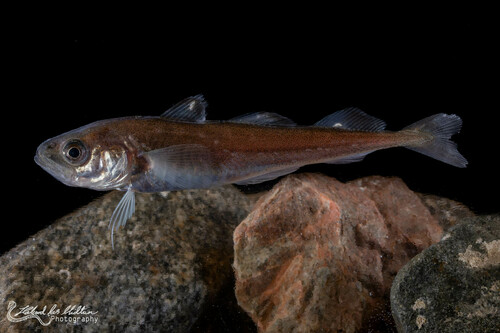
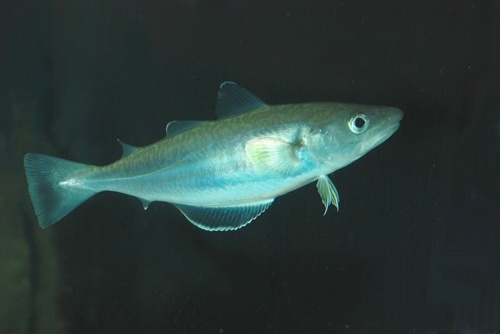
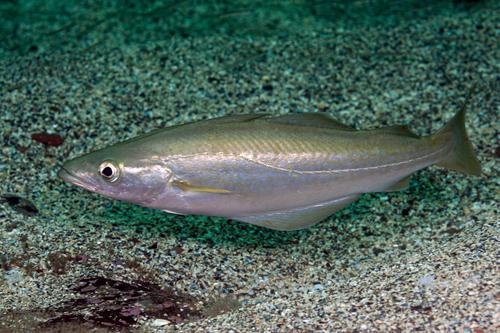
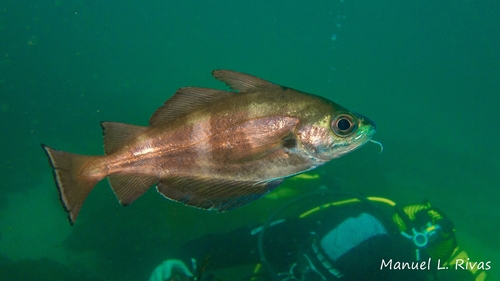
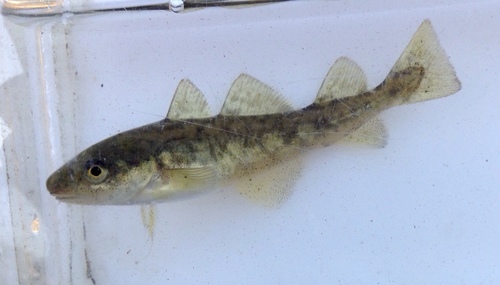
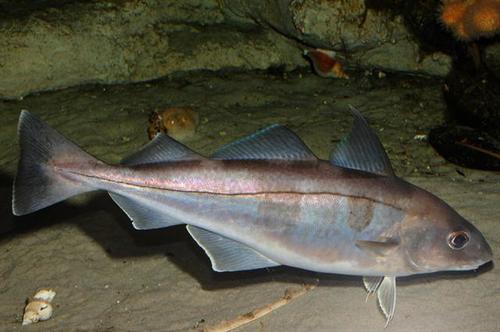
Haddock (Melanogrammus aeglefinus) has an elongated, tapering body shape typical of members of the cod family. It has a relatively small mouth that does not extend below the eye; the lower face profile is straight and the upper profile is slightly rounded, giving its snout a characteristic wedge shape. The upper jaw projects further beyond the lower jaw than it does in Atlantic cod, and there is a small barbel on the chin. It has three separate dorsal fins: the first is triangular, with 14 to 17 fin rays, the second has 20 to 24 fin rays, and the third has 19 to 22 fin rays. It also has two separate anal fins, with 21 to 25 fin rays in the first and 20 to 24 fin rays in the second. All dorsal and anal fins are separated from each other. The pelvic fins are small, with an elongated first fin ray. The upper side of the body ranges in colour from dark grey-brown to almost black, while the underside is dull silvery white. It has a distinctive black, slightly curved lateral line over the pectoral fins that contrasts sharply with the lighter body colour. It also has a characteristic oval black blotch or 'thumbprint', sometimes called the "Devil's thumbprint", located between the lateral line and the pectoral fin. This feature gives the genus Melanogrammus its name, which comes from Greek words melanos meaning "black" and gramma meaning "letter or signal". The dorsal, pectoral, and caudal fins are dark grey. The anal fins are pale, matching the silvery sides, with black speckles at their bases. The pelvic fins are white with a variable amount of black spots. Rare colour variants have been recorded, including barred individuals, golden-backed individuals, and individuals that lack the dark shoulder blotch. The longest recorded haddock was 94 centimetres (37 inches) long and weighed 11 kilograms (24 pounds). Haddock are rarely over 80 cm (31+1⁄2 in) long, and the vast majority of haddock caught in the United Kingdom measure between 30 and 70 cm (12 and 27+1⁄2 in). In eastern Canadian waters, haddock range from 38 to 69 cm (15 to 27 in) in length and 0.9 to 1.8 kg (2 lb 0 oz to 3 lb 15 oz) in weight. Haddock has populations on both sides of the North Atlantic, and is more abundant in the eastern Atlantic than on the North American side. In the northeast Atlantic, it occurs from the Bay of Biscay north to Spitzbergen, and is most abundant north of the English Channel. It is also found around Novaya Zemlya and in the Barents Sea in the Arctic. The largest stocks are in the North Sea, off the Faroe Islands, off Iceland, and off the coast of Norway; these are discrete populations with little interchange between them. Off North America, haddock is found from western Greenland south to Cape Hatteras, and the main commercially fished stock occurs from Cape Cod and the Grand Banks of Newfoundland. Haddock is a demersal species found at depths of 10 to 450 m (33 to 1,500 ft; 5.5 to 250 fathoms), and is most commonly found at 80 to 200 m (300 to 700 ft; 40 to 100 fathoms). It lives over substrates made of rock, sand, gravel, or shells, and prefers water temperatures between 4 and 10 °C (39 and 50 °F). Off Iceland and in the Barents Sea, haddock make extensive migrations, but in the northwestern Atlantic their movements are more restricted, consisting only of travel to and from spawning areas. Males reach sexual maturity at 4 years old, and females at 5 years old; the exception is the North Sea population, where males mature at 2 years old and females at 3 years old. The overall sex ratio is roughly 1:1, but females predominate in shallower areas, while males prefer deeper offshore waters. Female fecundity varies with size: a 25 cm (10 in) long fish carries 55,000 eggs, while a 91 cm (36 in) long fish carries 1,841,000 eggs. Spawning takes place at depths of around 50 to 150 m (200 to 500 ft; 30 to 80 fathoms). In the northwestern Atlantic, spawning occurs from January to July, and does not happen at the same time across all areas. In the northeastern Atlantic, the spawning season runs from February to June, peaking in March and April. The eggs are pelagic, with a diameter of 1.2 to 1.7 millimetres (3⁄64 to 9⁄128 in), and take one to three weeks to hatch. After metamorphosis, young post-larval haddock remain pelagic until they reach a length of around 7 cm (3 in), when they settle into a demersal lifestyle. Growth rate varies considerably by region. One-year-old haddock measure 17 to 19 cm (6+1⁄2 to 7+1⁄2 in), two-year-olds measure 25 to 36 cm (10 to 14 in), and 13-year-olds can reach 75 to 82 cm (29+1⁄2 to 32+1⁄2 in). The maximum lifespan of haddock is around 14 years. The most important spawning grounds are in waters off central Norway, off southwest Iceland, and over Georges Bank. Spawning fish in inshore waters are normally smaller and younger than those found offshore, and younger fish have a spawning season less than half as long as that of larger, older offshore stocks. After hatching, larvae generally do not travel far from their spawning grounds, though some larvae spawning off the west coast of Scotland are carried into the North Sea through the Fair Isle-Shetland Gap or to the northeast of Shetland. In their larval stage, haddock mainly feed on immature copepods, ostracods, and limacina. Their diet changes as they grow, shifting to larger pelagic prey such as amphipods, euphausiids, invertebrate eggs, and decapod zoea larvae, along with an increasing proportion of copepods. After they settle into their demersal post-larval stage, they gradually switch from pelagic to benthic prey. Adults primarily feed on benthic invertebrates such as sea urchins, brittlestars, bivalves, and worms, but will also feed opportunistically on smaller fish including capelin, sandeels, and Norway pout. Juvenile haddock are an important prey for larger demersal fish, including other gadoids, while seals prey on larger adult haddock. Recorded growth rates of haddock changed significantly over the 30 to 40 years leading up to 2011. Growth was more rapid in earlier recent years, with haddock reaching adult size much earlier than was recorded 30–40 years ago, but it remains unknown how much these larger, younger fish contribute to the population's reproductive success. Growth rates have since slowed in more recent years, and there is some evidence that this slower growth may be the result of an exceptionally large year class in 2003. Haddock stocks periodically have higher than normal productivity, for example in 1962 and 1967, and to a lesser extent in 1974 and 1999. These productive periods shift the species' distribution further south and strongly affect spawning stock biomass, but revivals do not have any lasting effect on the population due to high fishing mortality. From the 1960s to the early 1980s, recruitment was generally above average; this period of high recruitment, similar to that seen for Atlantic cod and whiting, is called the gadoid outburst. There was strong recruitment again in 1999, but recruitment rates have been very low since then. Haddock is a very popular food fish. It is sold fresh or preserved by smoking, freezing, drying, or to a small extent canning. Along with Atlantic cod and plaice, it is one of the most popular fish used in British fish and chips. When fresh, haddock flesh is clean and white, and it is cooked in a similar way to cod. Fresh haddock fillets are firm, translucent, and hold together well, while less fresh fillets become nearly opaque. In Boston, Massachusetts, young fresh haddock and cod fillets are often sold as scrod, a term referring to the size class of the fish. Haddock is the predominant fish choice for a fish supper in Scotland, and is the main ingredient of Norwegian fishballs (fiskeboller). Unlike cod, haddock is not suitable for salting, and is more commonly preserved by drying and smoking. The process of smoking haddock was highly refined in Grimsby, England. Traditional Grimsby smoked fish, which is mainly haddock but sometimes cod, is produced in traditional smokehouses in Grimsby, which are mostly family-run businesses that have developed their skills over many generations. Grimsby fish market sources its haddock from the Northeast Atlantic, mainly from Iceland, Norway, and the Faroe Islands; these fishing grounds are sustainably managed and have not experienced the large-scale stock depletion seen in EU waters. One popular preparation of haddock is Finnan haddie, named after the Scottish fishing village of Finnan (or Findon), where the fish was originally cold-smoked over smouldering peat. Finnan haddie is often poached in milk and served for breakfast. The Scottish east coast town of Arbroath produces Arbroath smokie, a hot-smoked haddock that requires no further cooking before eating. Naturally off-white, smoked haddock is frequently dyed yellow, like other smoked fish. Smoked haddock is the essential ingredient in the Anglo-Indian dish kedgeree, and in the Scottish soup Cullen skink.