About Melanodryas cucullata (Latham, 1802)
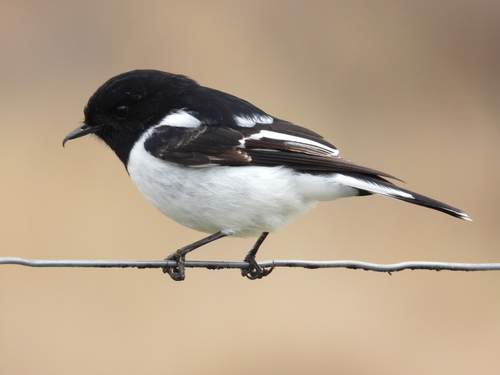
Melanodryas cucullata, commonly known as the hooded robin, is around 16 cm (6 in) in length and weighs an average of 22 grams. Males have a distinctive black-and-white pied coloration: they have a black head and neck, called the "hood", a white stripe along the shoulder, white chest and underparts. Their black wings feature white wing bars, their square-ended tail is white-tipped underneath, and has distinctive visible white panels on the dorsal side that are easy to see during flight. All males also have black eyes, bill, and feet. Females are plain grey-brown on the upper body, with a pale grey throat, paler underparts, dark brown wings, and white wing bars. Juveniles go through multiple moults over a 3-year period. Juvenile males first have dark brown plumage on the head and upper body, which sometimes has lighter brown or off-white feather tips. Their breast feathers are dark brown and mottled, but their wings and tail have a distinctive lighter bar from an early age, which helps with identification. Approximately 50% of juvenile males finish replacing their dark brown plumage with the adult's black hood by the start of the third year, through successive moults. Juvenile females look much more like adult females, but their juvenile feathers are darker brown; these darker feathers are replaced during moulting to the lighter brownish-grey plumage of the adult female. Historically, the Tiwi hooded robin subspecies has been recorded on both Bathurst Island and Melville Island. The south-eastern hooded robin is found from far southeast Queensland through to the southeast corner of South Australia. The subspecies M. c. picata occurs across the northern arid regions of Australia, while M. c. westralensis occurs across the southwestern arid regions of Australia, with their distributions overlapping in the central arid zone. The hooded robin does not occur in Tasmania, the Nullarbor Plain, Cape York, or the inland area around the Simpson Desert. The hooded robin prefers dry open forests that mix acacia and eucalyptus trees with shrubs that provide perching spots relatively close to the ground. It does best in areas with nearby native grass cover that has open patches, plus a mix of logs, fallen branches, and deeper soils. This environment creates ideal breeding conditions for small lizards and arthropods, which are the hooded robin's preferred prey. Thick patches of exotic grasses and large areas with no grass reduce the hooded robin's ability to forage successfully. Although the species was previously recorded in wetter forests near Armidale, New South Wales, recent surveys conducted over the last 15 years have not been able to confirm it is still present there.