About Melanocorypha yeltoniensis (J.R.Forster, 1768)
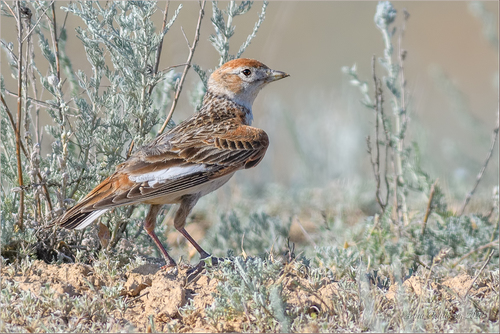
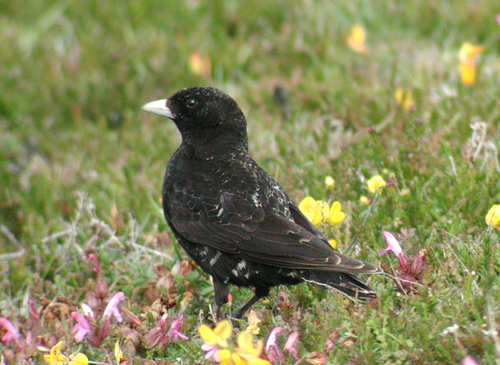
Melanocorypha yeltoniensis, commonly called the black lark, is a large, robust lark that measures 18–20.5 cm (7.1–8.1 in) in length. Adult males are unmistakable, with entirely black plumage marked by pale feather fringes on the back, and a yellowish or pink bill. By comparison, females are far less distinctive; they are mainly grey with dark blotches on the upperparts, and paler on the underparts. Females have black legs and black underwings. The species' song is a frantic version of the song of the Eurasian skylark.
Black larks inhabit open steppe environments, often located near water. The species is partially migratory: birds from the northwest portion of its breeding range move southeast to winter across deeper parts of Russia and neighboring countries, reaching as far as the northern Black Sea coasts of southern Ukraine. Away from its breeding range, the black lark is a very rare vagrant, with records from spring passage, autumn passage, and winter. Below is a complete list of European records outside the species' breeding and normal wintering ranges, current as of 2005: 1803, Italy; 19th Century (autumn, unknown date), Austria: one male at Alessandria, Piedmont; between 1857 and 1874 (unknown date), Austria: three males, one shot, at Breitensee, Vienna; 27 April 1874, North Sea: one female on Heligoland, then under British control; 27 July 1892, North Sea: one male on Heligoland, then under German control; March 1897, Moldova: one individual; March 1900, Romania: one individual in Dobruja; 14 October 1914, Turkey: one individual at Küçükçekmece, Istanbul; winter 1929, Malta: one individual; spring 1930, Greece: one individual at Athens; 20 April 1958, Greece: one male at Athens; 3 May 1961, Italy: one individual at Manfredonia, Apulia; 20 February 1963, Greece: a flock of eight at Lake Koronia; 8 February 1964, Greece: two individuals at the Axios Delta; 28 November 1981, Czech Republic: one male at Zakupy; 27 April 1984, Great Britain (England): one male at Spurn, Yorkshire; 17 January 1988, Poland: one individual at Kosienice; 24 March 1989, Finland: one male at Joensuu; 8 April 1989, Finland: one male at Korpo; 6 and 7 May 1993, Sweden: one male at Karlstad; 25 May 1995, Bulgaria: one female at Cape Kaliakra; 1 to 8 June 2003, Great Britain (Wales): one male at RSPB South Stack, Anglesey. One additional individual was recorded in Lebanon on an unknown date before 2003.
In terms of behaviour and ecology, the black lark builds its nest on the ground, and lays clutches of 4 to 5 eggs. Its diet consists of seeds and insects; insects make up a particularly large part of its diet during the breeding season. It is gregarious during the winter.