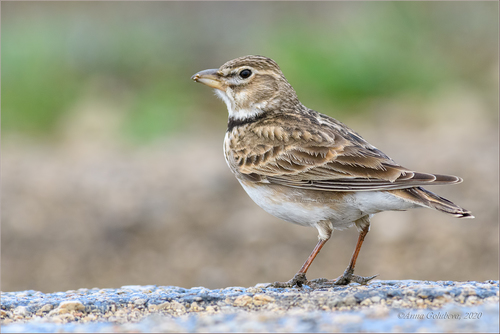
About Melanocorypha calandra (Linnaeus, 1766)
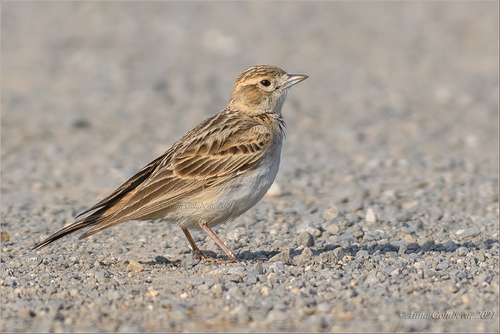
Melanocorypha calandra, the calandra lark, is a large, robust lark that measures 17.5–20 cm in length. When on the ground, it has a relatively plain appearance: it is mainly streaked greyish brown on the upperparts, white on the underparts, and has large black patches on the sides of the breast, plus a white supercilium. In flight, it displays short, broad wings that are dark on the underside, and a short tail with white edges. These wing and tail patterns set it apart from its more easterly relatives. Its song is similar to that of the skylark, but slower. This species is a passerine bird. In the western part of its range, it is mainly resident, while Russian populations are more migratory and travel further south for winter, reaching as far as the Arabian Peninsula and Egypt. It is a very rare vagrant to western Europe. Its preferred habitat is open cultivation and steppe, where it builds its nest on the ground and lays 4–5 eggs. It feeds primarily on seeds, and supplements its diet with insects during the breeding season. Outside of the breeding season, it forms gregarious groups. More specifically, this species occupies open plains ranging from steppes and pastures to extensive dry cereal cultivations, and also lives in true steppe with dense grass cover. In the Mediterranean Basin, it occurs mainly in dry pastures and dry cultivations. In cultivated areas, it prefers fallows, long-fallows and field edges; it occurs in sown fields to a lesser extent, and selects unirrigated legumes and barley fields. The species is monogamous, and lays eggs from early April to July. The nest is constructed from grass stems and small leaves, lined with softer material, and built in a shallow depression on the ground, often under a grass tussock. Clutches usually contain three to six eggs, according to de Juana and Suárez 2004. Its diet changes with the seasons: it feeds mostly on insects in summer, and on seeds and grass shoots in winter. Mediterranean populations are resident, and form large flocks in autumn and winter (Snow and Perrins 1998, de Juana and Suárez 2004). Eastern populations are migratory or partially migratory (de Juana and Suárez 2004). One documented parasite of the calandra lark is the chewing louse Ricinus vaderi, which was described from specimens collected in Azerbaijan.