About Melanochlora sultanea (Hodgson, 1837)
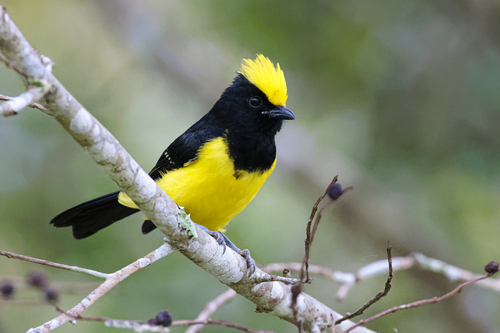
The scientific name of this species, the Sultan tit, is Melanochlora sultanea (Hodgson, 1837). It is the largest tit species, with a total length of 20–20.5 cm (7.9–8.1 in), a tail length of 8.2–9.9 cm (3.2–3.9 in), a wing length of 9.4–11.5 cm (3.7–4.5 in), a tarsus length of 2.1–2.6 cm (0.83–1.02 in), a bill length measured from the gape of 1.5–1.8 cm (0.59–0.71 in), and a body weight between 34 and 49 g (1.2 to 1.7 oz). Soft tissue colors are consistent across the species: the bill is black, the mouth is dark, the eyelids are grey, the iris is dark brown, the legs are grey, and the claws are dark horn. Unlike other members of the Paridae (tit family), its nostrils are exposed and not covered by feathers. Males have a brilliant yellow forehead, crown, and crest, with the exception of one subspecies where these areas are glossy black. All of the male's upper plumage, sides of the head and neck, chin, throat, and breast are deep black with a green gloss; the edges of upper plumage feathers have a metallic lustre, and the outermost tail feathers are tipped with white. From the breast downward, the male's lower plumage is deep yellow, and the thighs are barred or mottled with white. Males have a recumbent crest that raises when the bird is alert or alarmed. Females have duller yellow coloration than males; their upper plumage and sides of the head are dark greenish-brown, their chin and throat are glossy dark olive-green, their wings and tail are dull black, and the feathers of their upper plumage are edged with metallic green. Young birds resemble females, but the youngest individuals lack the bright edges on upper body plumage, and their greater wing coverts are edged with white. This species forages in the mid and upper canopy, usually alone or in small groups, and feeds mainly on insects including caterpillars, but sometimes also eats figs and small berries. It has a slow, fluttering flight. Its loud calls consist of short, repeated, variable whistling notes with a tit-like quality; recorded calls include a rattling "chi-dip, tri-trip", harsh explosive hissing calls, and repeated squeaky "wheet" whistles. In terms of taxonomy, in 1890 Richard Bowdler Sharpe classified this species as a member of the former subfamily Liotrichinae within the Timaliidae. A 2005 study found that Melanochlora sultanea has distinctive mtDNA cytochrome b sequences, suggesting it might not belong to the Paridae unless penduline tits are also included in the family. More recent, more detailed studies have clarified its placement: it sits in a near-basal position within the family Paridae, and is separate from penduline tits. Four subspecies are currently recognized. Ecologically, this species frequents large trees, and often forms small mixed-species flocks. In some forest areas such as the Buxa Tiger Reserve, population density has been estimated at around 15 individuals per square kilometre. In India, the breeding season runs from April to July. The species lays a clutch of five to seven eggs inside a lined tree cavity. Captive individuals exhibit an unusual panic response when exposed to unusual noise or other species, a behaviour reported to be unlike that of typical Paridae members. The Sultan tit has a large range, and is widely distributed across areas with suitable habitat. It is currently evaluated as Least Concern on the IUCN Red List of Threatened Species.