About Melanitis phedima Cramer, 1782
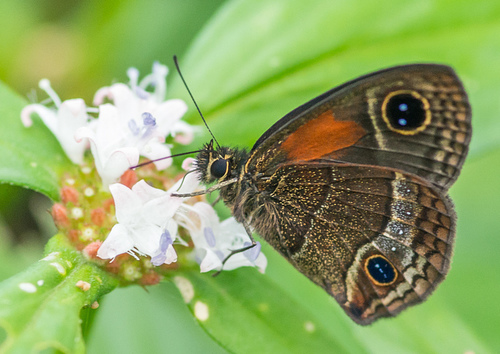
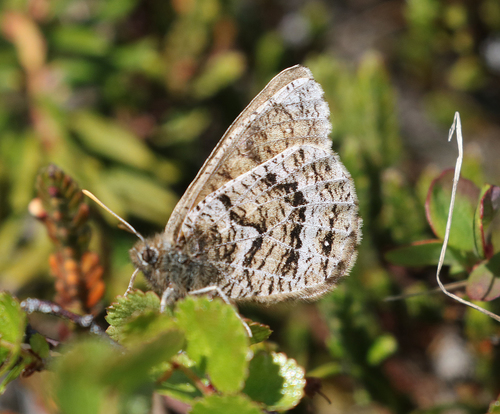
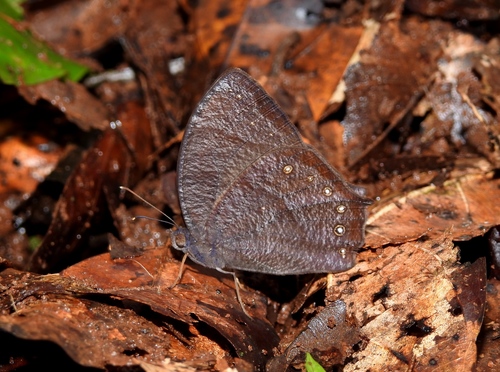
Melanitis phedima Cramer, 1782 has distinct wet-season and dry-season forms, with differing traits for each sex. Wet-season form: Male. Upperside is dusky fuliginous-brown, with palest outer borders and brown cilia. The forewing is very slightly angled below the apex, and has a well-defined, nearly round, subcostal ochreous patch before the apex that is divided by brown radial veinlets. The hindwing is unmarked. Underside is dark purpurescent-brown, densely and uniformly covered with ochreous-cinereous strigae, and has a ferruginous outer border. The forewing has four ordinary small obscure white-pupilled ocelli. The hindwing has a series of six submarginal prominent ocelli: the upper second is minute, the anal is geminated, the other four are nearly equal and much larger, and each is pupilled with white. Female. Upperside of both wings is much paler than in the male. The forewing is more broadly angled below the apex, and has a broadly pale ochreous entire apical area that holds a round black spot with a white pupil, located between the upper and middle median veinlets. There is also a minute obsolescent ocellus below this spot and three ocelli above it. The hindwing has a small posterior submarginal black spot between the middle and lower medians, which is pupilled with white. Underside of both wings has a pale purpurescent ochreous ground colour, densely covered with darker brown strigae. The basal area and outer borders of the discal fascia are slightly washed with pale purpurescent-cinereous. The ocelli match those of the male but are rather larger, and the outer margins are ochreous. The forewing has an obscure ochreous oblique medial fascia and a waved narrow discal fascia, and the hindwing has a similar excurved medial fascia; the hindwing fascia is somewhat more defined than the others. The underside of the body and the palpi are speckled cinereous-ochreous; legs are brown; antennae are brown, with a pale ochreous tip. Dry-season form: Male. Upperside is much deeper dusky-brown than in the wet-season form, with a purpurescent tint to the colour, and outer borders are thickly speckled with purpurescent-cinereous scales. The forewing has a more acute and prolonged angle below the apex than the wet-season male; the large apical patch is rich ochreous, darkest inwardly, and extends from within the end of the cell to the cinereous marginal border, with ocelloid spots obscurely defined. The hindwing is unmarked, and the tail is much prolonged. Underside is very densely purpurescent-brown or purpurescent olive-brown, with cinerescent strigae that are very irregular, more or less indistinctly arranged and mottled. The basal area is darkest, the outer discal area is washed with cinereous, and the ocelloid spots are smaller and very ill-defined. Female. Upperside is much paler than in the male, with less distinct cinereous margins. The forewing is even more acutely angled below the apex than the dry-season male; the rich ochreous apical patch occupies about half the wing, extends more or less well into the cell and to the posterior angle, and enclosed ocelloid spots match those of the wet-season female. Alternatively, two ordinary-disposed subapical black spots develop, both well-separated, more or less elongated, and each with a distinct white pupil. The hindwing has one or two posterior submarginal white dots. Underside of both wings is dusky ochreous, with uniformly arranged dark brown strigae that are sometimes more or less irregularly blotched; the submarginal ocelloid spots are also blotched. Recorded food plants are Ischaemum semisagittatum, Oplismenus compositus, Bambusa arundinacea, and a variety of grasses from the genera Andropogon, Cymbopogon, Pennisetum, and Setaria.