About Melanitis leda Linnaeus, 1758
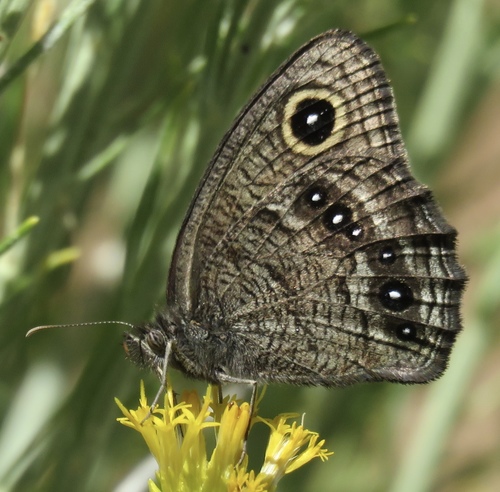
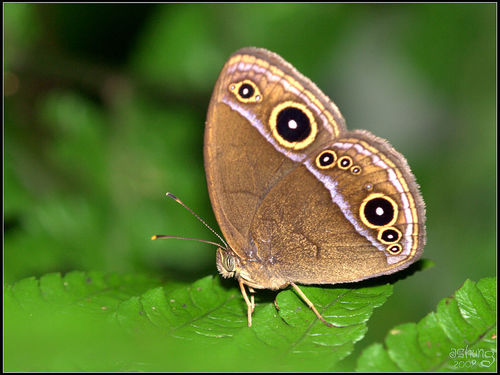
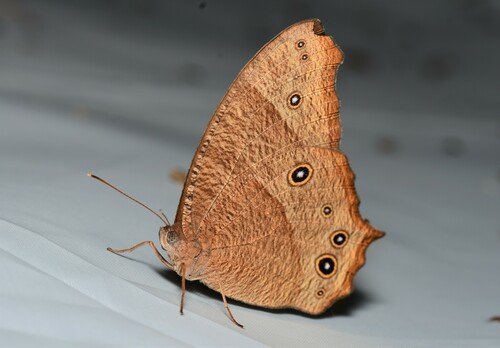
This species is Melanitis leda Linnaeus, 1758, and it has two distinct seasonal forms. The wet-season form has a forewing with a subacute apex, and a termen that is either slightly angled just below the apex or straight. The upperside is brown. The forewing has two large subapical black spots; each spot has a smaller pure white spot on its outer side, and is inwardly bordered by an interrupted ferruginous lunule. The costal margin is narrowly pale. The hindwing has a dark, white-centred, fulvous-ringed ocellus subterminally in interspace two, and the apical ocellus (and sometimes other ocelli) from the underside shows through. The underside is paler, and is densely covered with transverse dark brown striae. The forewing has a curved narrow dark brown discal band, followed by a similar oblique postdiscal band, which is then followed by a series of ocelli: four ocelli on the forewing, with the ocellus in interspace 8 being the largest; six ocelli on the hindwing, with the apical and subtornal ocelli being the largest.
For the dry-season form, the forewing has an obtuse apex that is more or less falcate; the termen posterior to the falcation is either straight or sinuous. The upperside ground colour is the same as that of the wet-season form, but the markings—especially the ferruginous lunules that inwardly border the black subapical spots on the forewing—are larger, and extend more above and below the black costa. On the hindwing, the ocellus in interspace 2 is absent, and is replaced posteriorly by three or four minute white subterminal spots. The underside colour varies greatly between individuals. For both seasonal forms, the antennae, head, thorax, and abdomen are brown or greyish brown; the antennae have white ring markings, and are ochraceous at the apex.
In terms of ecology, resident individuals of this butterfly chase off visitors to their territory during dusk hours. This chasing behaviour can be triggered even by pebbles thrown nearby. The caterpillars feed on a wide variety of grasses, including rice (Oryza sativa), bamboos, Andropogon, Rotboellia cochinchinensis, Brachiaria mutica, Cynodon, Imperata, and millets such as Oplismenus compositus, Panicum and Eleusine indica. Adults feed mainly on nectar, and only rarely visit rotting fruits.