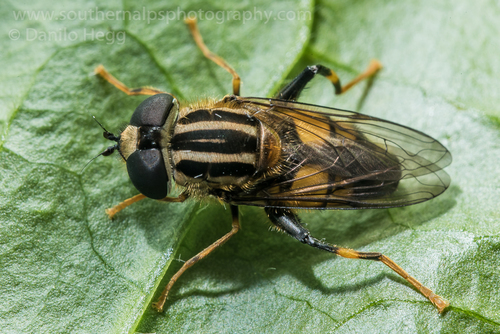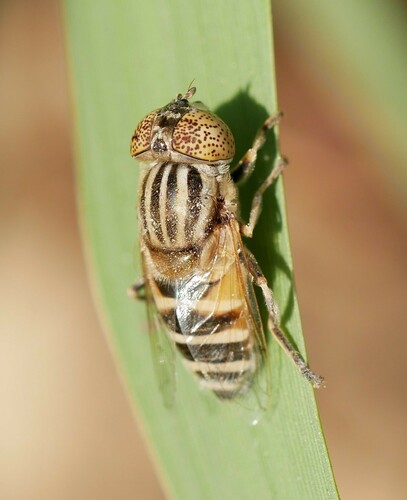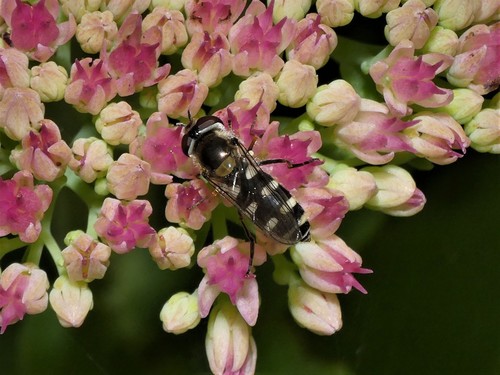
About Melangyna umbellatarum (Fabricius, 1794)
For a glossary of terms used in this description, please see the entry on Morphology of Diptera. Wing length of Melangyna umbellatarum ranges from 6.5 to 8.75 mm (0.256 to 0.344 inches). This species closely resembles Melangyna ericarum, but it can be distinguished by several key features. On the thorax, the disc bears pale hairs, while Melangyna ericarum has many black hairs on this area. The jowls of Melangyna umbellatarum have only pale hairs below the eyes, whereas Melangyna ericarum has some black hairs in this location. Tergite 2 of Melangyna umbellatarum has moderately large yellow side-spots that extend close to or over the side margins of the tergite; in Melangyna ericarum, these spots are widely set back from the tergite margins. The legs of Melangyna umbellatarum have distinct clear orange markings, which are obscure in Melangyna ericarum. The four anterior femora of Melangyna umbellatarum have few or none of the posterior black bristles that are present in Melangyna ericarum. For a full list of species characters and relevant references, see Bartsch et al. and Bei-Bienko, G.Y. & Steyskal, G.C. The male terminalia of this species are figured by Hippa. Melangyna umbellatarum is distributed across the Palearctic, ranging from Fennoscandia south to Iberia, from Ireland east through North Europe, Central Europe and South Europe, and continuing further east into European Russia and Siberia to Kamchatka. In the Nearctic, it occurs from Alaska to Arizona, though existing Nearctic records may instead refer to M. fisherii (Walton).