About Melanerpes superciliaris (Temminck, 1827)
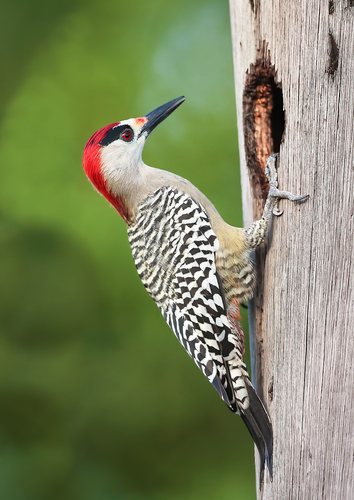
The West Indian woodpecker (Melanerpes superciliaris) measures about 27 to 32 cm (11 to 13 in) long and weighs 48 to 126 g (1.7 to 4.4 oz). Individuals from large islands are larger than those from small islands, and males are generally heavier and slightly larger than females. Males and females share the same plumage, differing only in head pattern. For the nominate subspecies M. s. superciliaris, adult males have a red crown, nape, and hindneck, with a black supercilium that extends to the red area. Adult females of this subspecies have a whitish crown, and the black supercilium extends around to separate the crown from the red nape. For adults of both sexes, the rest of the head is white to buffish white. Their upperparts are mostly barred black and buffy or yellowish white, with white uppertail coverts that bear a few black marks. Their flight feathers are black, with white bars and tips on both the primaries and secondaries. Their tail is mostly black, with wide white bars on the innermost and outermost pairs of feathers. Their underparts are grayish, with a buffy brown to pale yellow-olive tinge on the breast, whitish flanks and undertail coverts with black bars, and a red to orange red patch on the belly. Their iris is red to reddish brown, their bill is black, and their legs and feet are olive. Juveniles are duller overall than adults, have indistinct barring and often a reddish tinge on the upperparts, and have a larger but less distinct red patch on the belly. Juvenile males have a red crown patch, while juvenile females have a red crown with some black feathers. Subspecies M. s. nyeanus is much smaller than the nominate subspecies. It has only a very small black supercilium and a slight green tinge to the underparts. M. s. blakei is also much smaller than the nominate. It has a darker and grayer face and underparts, and a greenish-buff tinge to the pale bars on its upper back. M. s. murceus is the second largest subspecies after the nominate, and has essentially the same plumage as the nominate. M. s. caymanensis is smaller than M. s. murceus, but somewhat larger than M. s. nyeanus and M. s. blakei. It has no black markings on its face, and the female's hindcrown is grayish. The pale bars on its back are strongly buffish, and its black bars are narrower than those of the nominate subspecies. Its tail contains more white than the nominate's. Each subspecies of West Indian woodpecker has a distinct distribution: M. s. nyeanus occurs on San Salvador, and formerly occurred on Grand Bahama islands in the Bahamas; M. s. blakei occurs on Great and Little Abaco islands in the Bahamas; M. s. superciliaris occurs on mainland Cuba and many offshore islands and cays; M. s. murceus occurs on Isla de la Juventud (Isle of Pines), Cayo Largo and Cayo Real, though it may be extinct on the last two; M. s. caymanensis occurs on Grand Cayman island. The West Indian woodpecker subspecies on mainland Cuba and Isla de la Juventud inhabit a variety of wooded landscapes, especially those with abundant royal palms (Roystonea regia), at elevations between sea level and 1,000 m (3,300 ft). M. s. nyeanus on San Salvador is almost entirely restricted to dense broadleaf coppice vegetation with dead sabal palms (Sabal sp.). M. s. caymanensis inhabits most wooded landscapes on Grand Cayman, but is most abundant in forest on limestone areas with little soil, where vegetation is sparse and low. It avoids residential areas, open areas, and mangroves. M. s. blakei inhabits most types of available woodlands on the Abacos and is common in residential areas.