About Melanerpes striatus (P.L.S.Müller, 1776)
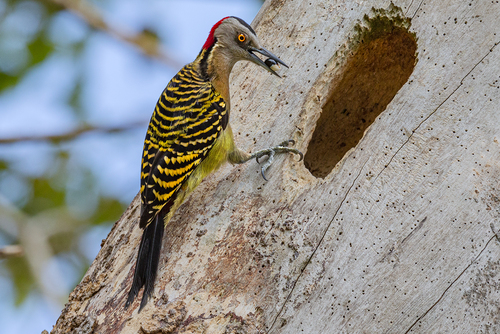
The Hispaniolan woodpecker, Melanerpes striatus, is a gold-and-black barred bird that grows to 22 to 28 cm (8.7 to 11.0 in) in length. Adult males are larger than females, have longer beaks, and sport a red crown and nape. The upper neck is black-and-white striped, while the back and wings have bold black-and-gold striping. The rump is greenish-yellow with red feather tips, and the upper side of the tail is black with red upper-tail coverts. The underside of the wings is greyish-brown with pale spotting and barring, and the underside of the tail is grey or olive. The fore-crown is grey or buff, the face and throat are grey, and the underparts are buff, brown or olive, with some dark streaking on the flanks. The iris is yellow, the beak is long, slender, and grey, and the legs are also grey. Adult females are similar to males but have a black crown and red nape. Juveniles have a black crown with white and red spotting, an orange nape, and a dark iris. This species is quite vocal, producing a range of sounds including yapping, squeaking, rolling, and nasal calls, and it only drums occasionally.
The Hispaniolan woodpecker is found in both Haiti and the Dominican Republic on the island of Hispaniola. It is primarily a woodland bird, and its range covers many of Hispaniola's biomes, including wet forests, dry forests, broadleaf forests, and coniferous forests. It also occurs in plantations, cactus scrub, mangrove areas, swamps, grasslands, palm groves, wooded agricultural areas, and urban parks.
This woodpecker forages in small, noisy groups. It has a varied diet that includes insects, spiders, scorpions, lizards, fruit, seeds, grain, and sap. It can catch flying insects mid-flight, and it bashes larger food items against an "anvil" to break them apart. Unlike most woodpeckers, the Hispaniolan woodpecker is a social species. It forms colonies that use the presence of many adult birds to protect nesting sites in banks or trees. A single colony can hold up to twenty pairs of birds, with several pairs nesting in the same tree. The birds excavate nests in tree trunks and branches, and their abandoned holes are reused by Hispaniolan amazons, Hispaniolan parakeets, Hispaniolan trogons, Antillean piculets, and golden swallows.