About Melanerpes radiolatus (Wagler, 1827)
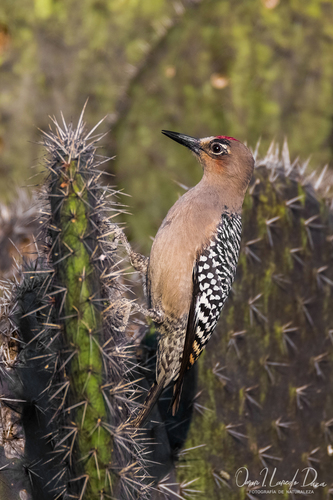
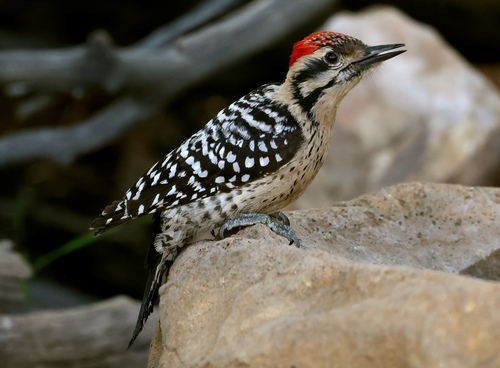
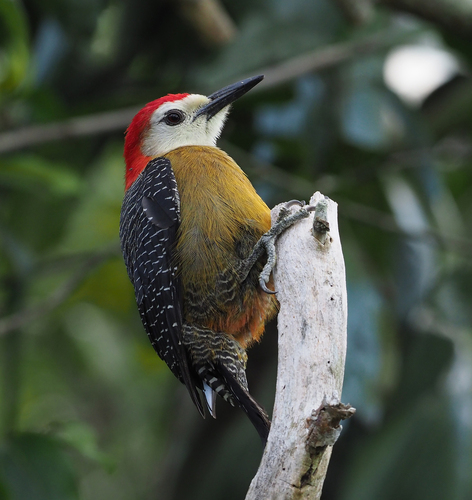
Melanerpes radiolatus (Wagler, 1827), commonly called the Jamaican woodpecker, measures 24 to 26 cm (9.4 to 10 inches) in length and weighs 92 to 131 g (3.2 to 4.6 ounces). The plumage of males and females is identical except for head patterning. Adult males have a whitish to buff forehead, with red coloring extending from the forecrown to the hindneck. Adult females share the same white to buffy white forehead, but have a gray crown, with red restricted to the hindcrown and hindneck. The species' upperparts are black with thin white bars that sometimes show a greenish tinge; these bars are widest on the rump and uppertail coverts. Flight feathers are black with narrow white bars covering their entire length. The tail is black, with some white bars on the central pair of tail feathers and white spots on the outermost pair. The lores are yellowish, while the cheeks, chin, and throat are white. Underparts are mostly olive-gray to olive-buff, with yellowish to reddish coloring on the central belly; lower flanks and undertail coverts are black with white bars. The bill is long and black, the iris is red, the bare skin surrounding the eye ranges from gray to brown, and the legs are slaty black. Juveniles are duller in color than adults, with grayer underparts but a yellower central belly. Juveniles have brown eyes, and both sexes have red on the crown, though females have less red than males. The Jamaican woodpecker is found across the entire island of Jamaica. It lives in a wide range of wooded habitats, including lower montane rainforest, wet misty forests, mangroves, wooded pastures, citrus and coconut plantations, and gardens. It reaches its highest population density in mesophytic secondary forest. It occurs at all elevations, ranging from sea level up to Jamaica's highest mountains.