About Melanerpes pygmaeus (Ridgway, 1885)
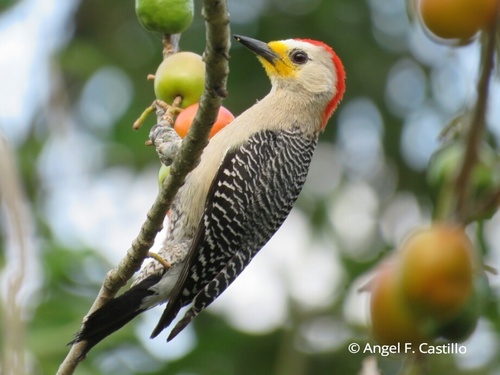
The adult Yucatan woodpecker (Melanerpes pygmaeus) measures 17 cm (6.7 in) long. Adult individuals have mainly light gray faces and underparts, with black and white barred patterns across their back, wings, and tail. Adult males have a red cap extending from the eye to the nape, while females only have red on the occipital area of the cap. Yellow feathers surround the base of the bird's bill, the belly may show a yellowish tinge, and the vent area may have a red wash. The Yucatan woodpecker's plumage is very similar to that of the golden-fronted woodpecker (Melanerpes aurifrons), which occurs across the entire Yucatán Peninsula, making the two species very hard to tell apart in the field. The far more common golden-fronted woodpecker is larger in body size, has a longer beak, and females have more red on the nape than female Yucatan woodpeckers. Golden-fronted woodpeckers have reddish feathers at the base of the bill, unlike the yellow bill-base feathers of the Yucatan woodpecker. From a distance, the back barring of the golden-fronted woodpecker looks blackish, while the Yucatan woodpecker's back barring has a silvery appearance. The vocalizations of the two species also differ noticeably. While the Yucatan woodpecker is also similar in appearance to the red-crowned woodpecker (Melanerpes rubricapillus), the two species have non-overlapping distributions. The Yucatan woodpecker is endemic to Central America. Its range covers the Yucatán Peninsula, its adjoining offshore islands including Cozumel Island, Belize, northeastern Guatemala, and Guanaja Island off the coast of Honduras. It occurs most often in clearings, dry woodland edges, and coastal scrub, but it also sometimes occupies damper woodland and degraded habitats.