About Melanerpes portoricensis (Daudin, 1803)
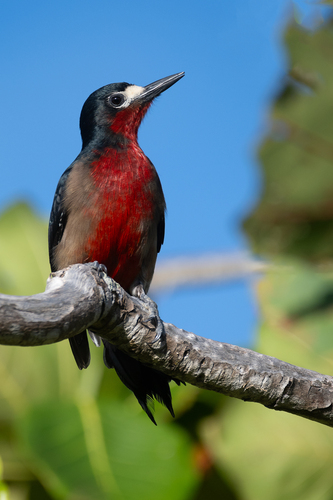
The Puerto Rican woodpecker, scientific name Melanerpes portoricensis (Daudin, 1803), has a black body with bright red throat and breast. A white patch stretches across its head from eye to eye, and its flanks and lower body are colored light tangerine. Like most bird species, the Puerto Rican woodpecker exhibits sexual dimorphism. Males have brighter colored throats and breasts than females, and females are generally duller in overall coloration. The sexes have an approximately 18% difference in bill length, and males are slightly larger than females. This species has an average weight of 56.0 grams, and its body length ranges from 23 to 27 centimeters. The Puerto Rican woodpecker is a common, widely distributed species native to Puerto Rico, where it lives mainly in forests, coffee plantations, mangroves, palm groves, parks, and gardens. In addition to its current range in Puerto Rico, the species once inhabited the island of St. Croix. During the Pleistocene epoch, Puerto Rico, Vieques, Culebra, St. Croix, and the other Virgin Islands formed a single landmass, and researchers believe the species extended its range to St. Croix and Vieques at that time.