About Melanerpes formicivorus (Swainson, 1827)
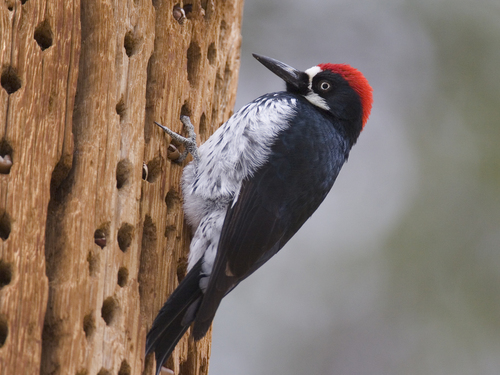
Melanerpes formicivorus, commonly known as the acorn woodpecker, can be identified by the following adult physical characteristics. Adults have brownish-black heads, backs, wings, and tails, with white foreheads, throats, bellies, and rumps. Fledglings start with dark eyes that turn white within a few months. Adults have a small patch of greenish feathers on their lower back. While the species is mostly dark, adult males have a red cap that extends to the forehead, while females have a black area between their forehead and red cap. The distinct white patches on the neck, throat, and forehead are key identifying features. When flying, acorn woodpeckers alternate a few wing flaps with a short drop of around one foot, and white circles on their wings become visible during flight. Their call sounds similar to human laughter. This species measures 19–23 cm (7.5–9.1 in) in length, weighs 65–90 g (2.3–3.2 oz), and has a wingspan of 35–43 cm (14–17 in). The acorn woodpecker inhabits oak-dominated forested areas. Its range extends from coastal Oregon, California, and the southwestern United States, south through Central America to Colombia. It occurs at lower elevations in the northern part of its range, but is rarely found below 1,000 m (3,300 ft) in Central America, and breeds as high as the timberline. Acorn woodpeckers excavate their nest cavities in dead trees or dead sections of living trees. As their common name suggests, acorn woodpeckers rely heavily on acorns as a food resource. For California populations, acorns are so important that acorn woodpeckers will sometimes nest in the fall to use the seasonal acorn crop, a behavior that is rare among birds. They store acorns in small drilled holes called granaries that are located in storage trees, most often snags, dead branches, utility poles, or wooden buildings. Storage holes are always drilled into dead tree tissue such as bark or dead limbs, and are reused year after year. Granaries can hold thousands of holes, with each hole holding one acorn during autumn. The availability of acorn crops affects the structure of acorn woodpecker social communities. In a study conducted in Arizona, during the 1976 poor acorn crop year, around 90% of adults per social unit were non-breeding. In 1977, when acorn production increased significantly, the number of non-breeding adults per social unit dropped correspondingly. Even though acorns are a key backup food, acorn woodpeckers primarily feed on insects, sap, and fruit. They can be observed sallying out from tree limbs to catch insects, eating fruit and seeds, and drilling holes to access sap. When storing acorns, the birds place each acorn into a hole sized to fit it. As stored acorns dry and shrink, the birds move them to smaller holes, so granary maintenance takes up a large amount of the birds' time. Stored acorns are left visible, and the social group defends its granary against cache robbers such as Steller's jays and western scrub-jays. In the more tropical parts of this species' range, acorn woodpeckers do not build traditional granary trees. Instead, they store acorns in natural holes and bark cracks. When the acorn crop is poor and birds cannot collect enough to store, they will move to other areas for the winter.