About Melanerpes flavifrons (Vieillot, 1818)
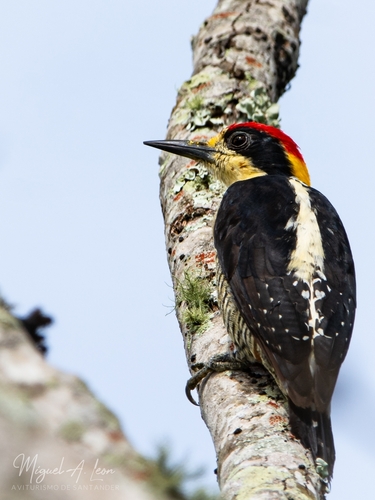
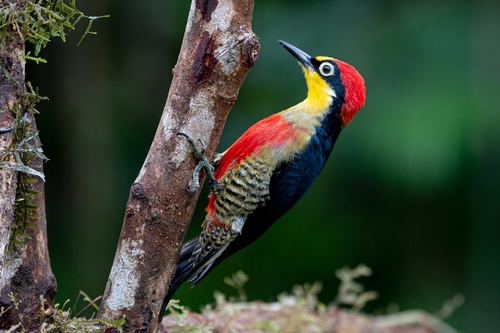
This colourful woodpecker reaches approximately 18 cm (7 in) in length. Males and females look similar, with one key difference: males have a red crown and nape, while females have bluish black colouring in this same region. Both sexes share a set of common markings: a yellow fore-crown, yellow cheeks, yellow chin and yellow throat, plus a broad black band that runs from the base of the beak, through the eye, to the nape. The mantle and upper wings are mostly black, while the back and rump are white. The tail is black with some white barring on the outer feathers. The breast is grey or olive, the belly is red, and the flanks are barred black and white, or black and buff. The iris is blue-black, and the clear orbital ring is yellowish or orange. The beak is black, and the legs and feet are olive-brown. Juveniles resemble adults, but are less glossy, generally browner, and have less red on the belly and crown. The yellow-fronted woodpecker is native to eastern South America. Its range covers eastern and southeastern Brazil, eastern Paraguay and northeastern Argentina, and it occurs at altitudes from sea level up to around 1,800 m (6,000 ft). It is a resident, non-migratory species, found in sparsely forested areas, gallery forests, secondary forests, palm groves, orchards, gardens and parkland. It especially occurs in locations where isolated trees remain standing after the surrounding area has been cleared. This species has a mixed diet, with berries and fruits making up the majority of its food. It also eats seeds, insects and insect larvae. Across most of its range, breeding occurs between January and May. Nestlings have been observed being fed fruits, and both insects and fruits are sometimes stored to eat later. This species is a cooperative breeder: multiple birds nest close to one another, and some birds act as non-breeding helpers.