About Melanerpes erythrocephalus (Linnaeus, 1758)
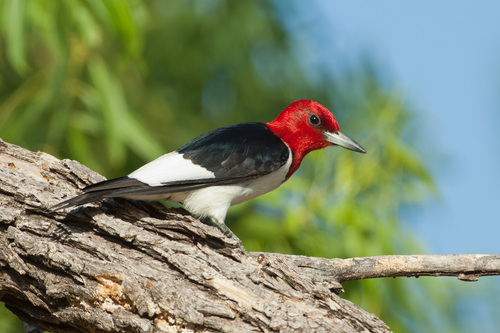
This species is Melanerpes erythrocephalus (Linnaeus, 1758), commonly called the red-headed woodpecker. Adult red-headed woodpeckers are distinctly tricolored, with a black back and tail, white belly and rump, and red head and neck. Their wings are black with white secondary remiges, and adult males and females have identical plumage. Juveniles have similar markings to adults, but have grey heads. All red-headed woodpeckers have entirely crimson plumage above their shoulders. This is a mid-sized woodpecker species. Both sexes measure 19 to 25 cm (7.5 to 9.8 in) in total length, with an average wingspan of 42.5 cm (16.7 in). They weigh between 56 and 97 g (2.0 to 3.4 oz), with an average weight of 76 g (2.7 oz). Individual wing length ranges from 12.7–15 cm (5.0–5.9 in), tail length ranges 6.6–8.5 cm (2.6–3.3 in), bill length ranges 2.1–3 cm (0.83–1.18 in), and tarsus length ranges 1.9–2.5 cm (0.75–0.98 in). The maximum recorded longevity of this species in the wild is 9.9 years. To mark territory, this species gives a tchur-tchur call or drums. The red-headed woodpecker is omnivorous, feeding on insects, seeds, fruits, berries, and nuts; it occasionally eats small rodents, and even the eggs of other birds. Around two-thirds of its total diet is made up of plant matter. Red-headed woodpeckers store food caches, a food-storing behavior only recorded in three other woodpecker species: the acorn woodpecker, the downy woodpecker, and the red-bellied woodpecker. They stuff stored food into tree cavities, crevices, and under tree bark, which provides them with food throughout the year.