About Melanerpes cruentatus (Boddaert, 1783)
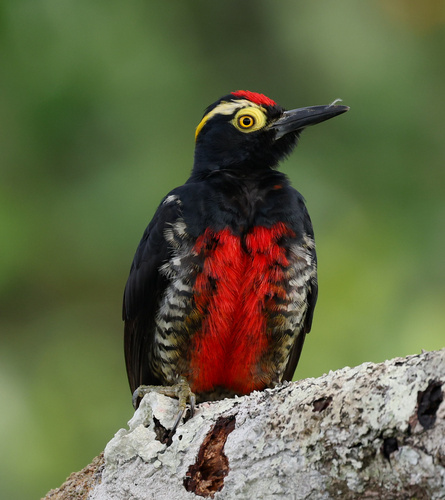
Adults of this species reach roughly 20 cm (8 inches) in total length. The upperparts of the body, along with the cheeks, chin, throat, and chest, are mostly bluish-black. The breast and belly are red, though the extent of this red coloration varies between individuals. The flanks and lower belly show undulating black-and-white barring. The rump and upper tail-coverts are white, a marking that is clearly visible when the bird is in flight, and the tail itself is solid black. The underside of the wing is patterned with black-and-white barring. The beak is blackish, the legs are grey, and both the iris and the orbital ring are yellow. Males can be distinguished from females by the color of the fore-crown and mid-crown: these regions are red in males and black in females. In northern and western geographic races, the brow is yellow, cream, or buff, and the hind-crown has yellow or golden feathers that are often tufted. In southern races, these same areas are black. Juvenile birds resemble adults, but have browner upperparts and greyer underparts. Both male and female juveniles have some red coloration on the crown, and their belly is orange rather than red.
This species, the yellow-tufted woodpecker, is native to northern South America. Its known range covers eastern Colombia, western and southern Venezuela, the Guianas, northern and central Brazil, eastern Ecuador, eastern Peru, and eastern Bolivia. It generally occurs at altitudes from sea level up to around 1,200 m (3,900 ft), and can be found at even higher elevations in Ecuador. It inhabits open humid forest, including both varzea and terra firme forest types, and also occurs in secondary forest, woodland verges, and burnt-out areas that retain isolated standing trees. It does not migrate.
This woodpecker is social and gregarious, and often forages in groups. It is omnivorous, with a diet made up primarily of insects (some of which it catches while in flight) and fruit.