About Melanerpes carolinus (Linnaeus, 1758)
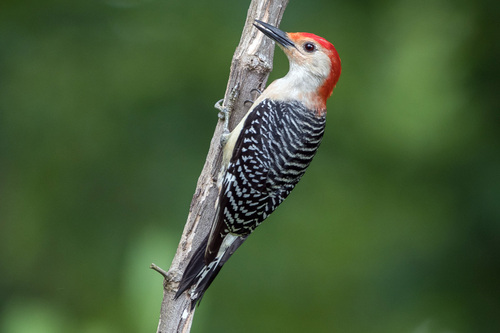
Adults of this species, the red-bellied woodpecker, have mainly light gray coloring on the face and underparts, with black and white barred patterns across their back, wings and tail. Adult males have a full red cap that extends from the bill to the nape, while females have one red patch on the nape and another red patch above the bill. The reddish tinge on the belly that gives the bird its common name is difficult to spot during field identification. When the bird is in flight, white patches on its wings become visible. Red-bellied woodpeckers measure 22.85 to 26.7 cm (9.00 to 10.51 in) in total length, have a wingspan of 38 to 46 cm (15 to 18 in), and weigh between 2.0–3.2 oz (57–91 g). In terms of behavior and ecology, these birds mostly search for arthropods on tree trunks, but may also catch flying insects mid-flight. They are omnivorous, with a diet that includes insects, fruits, nuts and seeds. In some parts of their range, they will also eat the eggs of box-nesting Wood ducks. Their typical breeding habitat is deciduous forests. They nest inside decayed cavities of dead trees, old stumps, or live trees with softer wood such as elms, maples, or willows. Both sexes work together to dig out nesting cavities, and they mark areas around nest sites with drilling holes to warn other individuals to stay away. While this species is not globally threatened, it depends on large trees for nesting. In heavily deforested areas, the birds will sometimes use gardens for habitat, but they generally do not occur in large numbers in these landscapes. To forage for food, the red-bellied woodpecker uses its bill like a chisel, drilling into bark or probing cracks in tree trunks. It can pull beetles and other insects out of trees with the help of its long tongue. Field observations confirm that these woodpeckers regularly store food, hiding items like berries and acorns deep in natural crevices to protect the food from competing species. Multiple studies (Williams 1975, Breitwisch 1977, Williams and Batzil 1979) found that red-bellied woodpeckers spend between 20% and 69% of their foraging time on dead or decaying trees. Breitwisch (1977) additionally observed that red-bellied woodpeckers in South Florida pine habitat primarily used gleaning and probing to find food. The red-bellied woodpecker depends on snags or dying trees both for foraging and nesting. In the U.S. Midwest, it is a major predator of the invasive emerald ash borer, and can remove up to 85 percent of borer larvae from a single infested ash tree. Red-bellied woodpeckers have occasionally been observed foraging on the ground alongside groups of northern flicker woodpeckers.