About Melanerpes candidus (Otto, 1796)
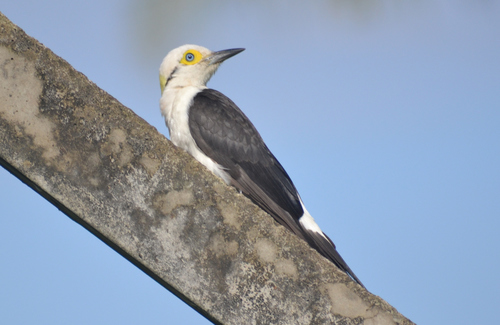
This species, the white woodpecker Melanerpes candidus (Otto, 1796), reaches an adult length of 24 to 29 cm (9.4 to 11.4 in). Its weight averages around 108 g (3.8 oz), with a total weight range of 98 to 131 g (3.5 to 4.6 oz). It is among the largest Melanerpes woodpeckers, alongside the Jamaican woodpecker and Lewis' woodpecker. For adult individuals, the mantle, back, wings and tail are black: flight feathers are brownish-black on their upper surface, while the underside of the wings is greyish-black. The crown, face, rump and underparts are white, occasionally with subtle buff shading. Males have yellow coloring on the breast and nape that females do not have, and yellow is present on the belly of both sexes. A narrow black stripe runs from behind the eye back to the nape. There is a bare ring of yellow skin surrounding the eye, which has a yellowish iris. The long beak is grey, and paler near its base, and the legs are also grey. Juveniles are browner and less glossy than adults, with pale buff areas instead of the white pale areas seen in adults. Juveniles have a grey orbital ring rather than the yellow ring of adults, and both juvenile sexes may have yellow on the nape. The white woodpecker has a large range in South America east of the Andes Mountains. Its distribution extends from Suriname and French Guiana, through most of Brazil, to southeastern Peru, Bolivia, Paraguay, Uruguay and northern Argentina. It occurs at altitudes up to approximately 2,000 m (6,600 ft). It is a non-migratory species, though it regularly makes short-distance movements. Its preferred habitats include forest edges, open dry woodland, wooded savannah, scrubland with scattered trees, plantations, orchards, parkland and mangroves. It is an opportunistic, adaptable species, and can even be found in city suburbs; it is currently expanding its range into areas where timber has been felled. Groups of up to ten white woodpeckers are sometimes observed flying in procession, using slow floppy wing beats. It has a varied diet that includes fruits, berries and seeds, and the species acts as a significant seed disperser for several plant species. It forages in noisy family groups, and also raids the nests of wild bees and wasps to feed on adult insects, larvae and honey. Its breeding season falls between September and November. It may occasionally nest communally, but very little detailed information is available about its overall breeding habits.