About Melanerpes aurifrons (Wagler, 1829)
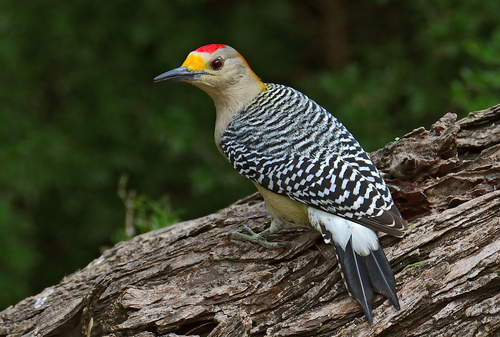
The golden-fronted woodpecker, Melanerpes aurifrons (Wagler, 1829), measures 22 to 26 cm (8.7 to 10 in) in length and weighs 65 to 102 g (2.3 to 3.6 oz). Males and females share the same plumage except for the pattern on their heads. Adult males have a red crown and a golden orange to yellow nape, with a gap between the two regions; females have a grayish crown and a paler yellow nape. For adults of both sexes, the rest of the head is colored in various shades of gray. Their upperparts are mostly patterned with black and white bars, and they have white uppertail coverts that bear a few black spots. Their flight feathers are black, with variable amounts of white on the primaries. Their tail is mostly black, with variable amounts of white on the outermost three pairs of feathers. Their underparts range from smoke gray to drab gray, with light blackish bars on the flanks and undertail coverts, and a yellow patch on the belly. Their iris is deep red to reddish brown, their bill is black to grayish black, and their legs and feet are grayish green to greenish gray. Juveniles are duller overall than adults, with little to no orange on the nape, indistinct barring on the upperparts, and fine dusky streaks on the underparts. Juvenile males have a small red crown patch, while juvenile females only have a few red feathers in this area. The golden-fronted woodpecker's range extends from southwestern Oklahoma through central Texas onto the Mexican Plateau, reaching as far south as Jalisco, San Luis Potosí, and Hidalgo. It is a casual visitor to New Mexico and East Texas, and has been recorded once each in Michigan and Florida. This species inhabits both mesic and xeric landscapes, and it favors xeric habitats including mesquite brushlands and riparian woodlands. It also commonly occurs in urban parks and suburban areas.