About Melampyrum cristatum L.
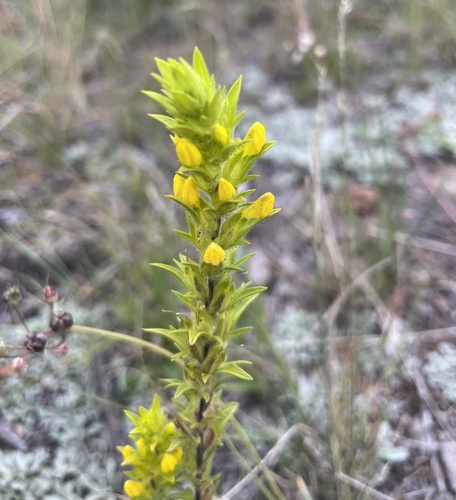
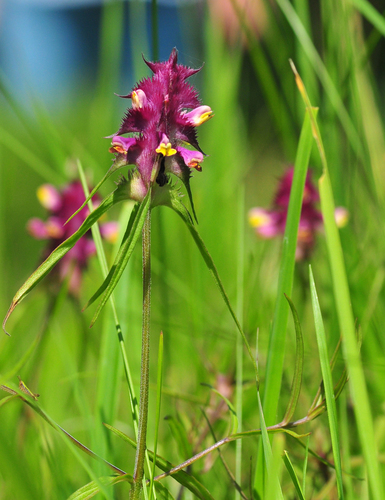
Melampyrum cristatum L. is an annual herb species that reaches 15 to 40 centimeters in height. Its stems are erect and reddish-green. Its leaves are 5 to 10 centimeters long, nearly stalkless, and narrowly elliptic. Its flowers are tubular and purple, but the flower lips are yellow. This species flowers from July to August. Seeds develop inside flat capsules that are 10 millimeters long. The seeds have soft, oily elaiosomes, which ants collect, eat, and disperse. This species is native to Albania, Altai, Austria, the Baltic States, Belarus, Belgium, Bulgaria, Corsica, Crete, Czech Republic, Denmark, Finland, France, Germany, Great Britain, Hungary, Italy, Kazakhstan, North Caucasus, Norway, Poland, Romania, Russia, western Siberia, Slovakia, Spain, Sweden, Switzerland, European Turkey, Ukraine, and Yugoslavia. It has been introduced outside its natural range to Krasnoyarsk. Melampyrum cristatum is associated with woodland habitats, growing in woodland clearings, woodland margins, and along river banks. It also grows in human-made habitats including hedgerows and roadsides, and benefits from managed woodlands where coppicing is still practiced. It is also sometimes found in grassland habitats such as rocky hillside meadows. It is a calcicole that thrives in lime-rich soils, and can grow in both chalky and clay soils. Like all species in the Melampyrum genus, Melampyrum cristatum is a parasite that obtains nutrients from other host plant species. It has retained the ability to photosynthesize despite obtaining nutrients from hosts, which makes it a hemiparasite. The seeds of this species have soft, oily elaiosomes that are collected and eaten by wood ants of the genus Formica. This relationship is mutualistic: the ants gain a food source, while the ants disperse the seeds, allowing Melampyrum cristatum to colonize new habitats.