About Melampyrum arvense L.
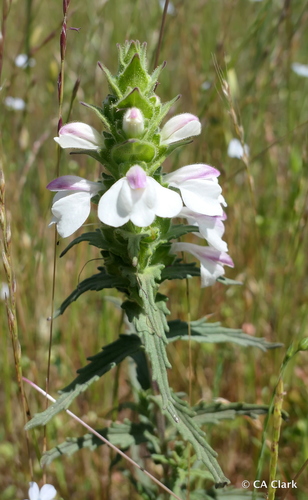
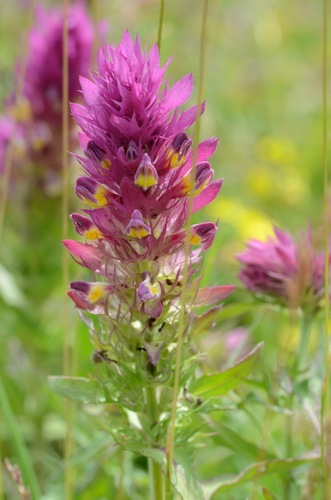
Melampyrum arvense L. has upright stems that may branch, and are topped by a spike of pink to purple bracts, among which its tubular flowers grow. Younger, lower bracts are green; the pink or purple colour develops and deepens over time. The plant reaches 40 to 60 cm in height. Its typical leaves are lanceolate, arranged opposite one another, and may have short teeth. The bracts are also lanceolate, with long teeth reaching up to 8 mm long. The flowers are two-lipped with a closed throat, measure 2 to 2.5 cm long, and are pink to purple with a yellow or white patch. This is a European species that flowers from June to September. It prefers dry habitats and chalky soil. It is distributed across most of Western Europe, but is absent from central and southern Spain, southern Italy, Ireland, Iceland, Norway, central and northern Sweden, and northern Finland. Its range extends east to the Ural Mountains, and it also occurs in Turkey. In Great Britain, it is only found in a small number of locations in south-east England. It is becoming rarer in at least Britain, France, Belgium, Germany, the Netherlands and Finland. This rarity may be caused by a reduction in the area of arable land, and changes to farming practices including seed-cleaning and agricultural intensification. This species is hemiparasitic, most commonly growing on the roots of grasses, but also on the roots of other plants. It cannot grow well without a host to obtain nutrients from. One experiment compared growth of M. arvense when growing on rye grass, alfalfa, and flax, and found the species grew best by far on the leguminous alfalfa. The species' flowers are pollinated by bumblebees. Its seeds are often dispersed by ants: each seed has a small oil body called an elaiosome that attracts ants, which carry the seeds back to their nests to eat. Like some other Melampyrum species, the undersides of M. arvense bracts have tiny nectar-producing glands that attract ants, bumblebees, and other insects. In M. arvense these glands are violet, visible under a hand lens, and shaped like minute scales around 0.45 mm in diameter that secrete a sugary solution.