About Melaleuca radula Lindl.
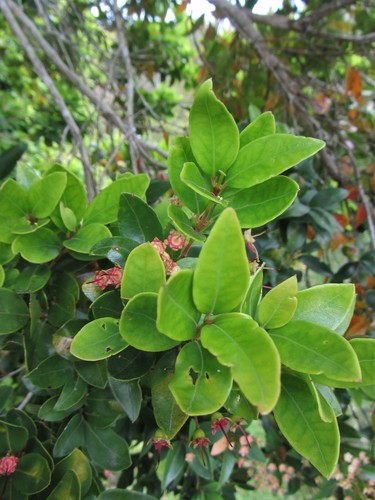
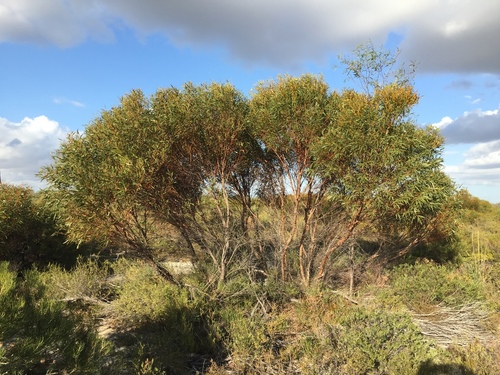
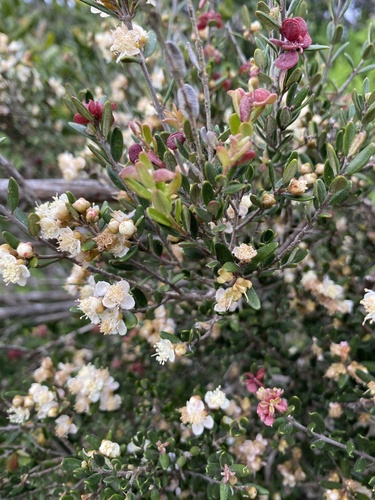
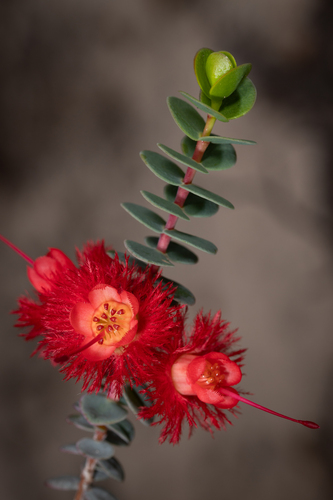
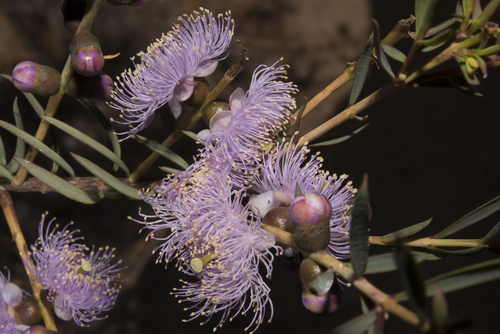
Melaleuca radula Lindl. is a spreading shrub that grows up to 5 metres (20 feet) tall, with coarse bark. Its leaves are arranged in decussate alternating pairs, forming four distinct rows along the plant’s branches. Individual leaves are 10 to 45 millimetres (0.4 to 2 inches) long and 0.7 to 2 millimetres (0.03 to 0.08 inches) wide, with a linear to elliptic shape. Their edges are turned upward, giving the leaves a crescent moon shape when viewed in cross-section, and prominent oil glands are visible on the lower surface of the leaf. The flowers are white, but more commonly grow in a pink to mauve shade. They are arranged in pairs of up to 5, positioned on opposite sides of branches to form a flower spike that reaches up to 40 millimetres (2 inches) long and 30 millimetres (1 inch) in diameter. The petals are 4.5 to 6.5 millimetres (0.2 to 0.3 inches) long, and drop off as the flower matures. Five bundles of stamens surround the flower, each holding 30 to 90 stamens, which gives the overall flower spike a fluffy appearance. Flowering most often occurs between July and September. After flowering, the plant produces woody, almost spherical capsules that are 4 to 6 millimetres (0.16 to 0.24 inches) in diameter, which grow in clusters along the stem. This species of melaleuca occurs in the Kalbarri, Perth, and Norseman districts and the area between these locations, within the Avon Wheatbelt, Coolgardie, Geraldton Sandplains, Jarrah Forest, Mallee, Murchison, Swan Coastal Plain, and Yalgoo biogeographic regions. It grows in sandy and gravelly soils, most often near granite or laterite, and close to creeks and streams. According to Noongar Aboriginal uses, the leaves of this plant are boiled in water to make an antiseptic mouthwash for treating sore gums, and the same preparation is used externally on sores and other skin problems. The prepared decoction is also used internally to treat upset stomachs and indigestion, and young leaves are chewed to relieve headaches. The compound terpinen-4-ol is thought to be responsible for the antibacterial and antiseptic properties of this melaleuca’s oil.