About Melaleuca nesophila F.Muell.
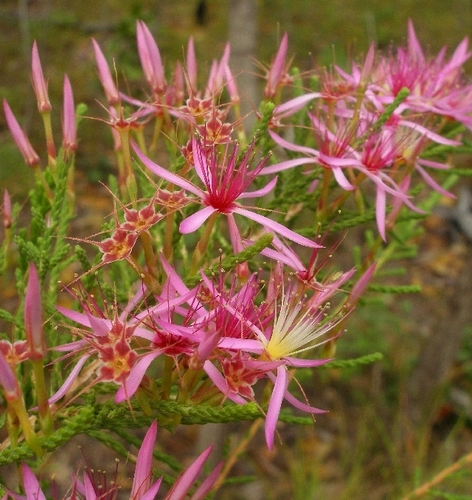
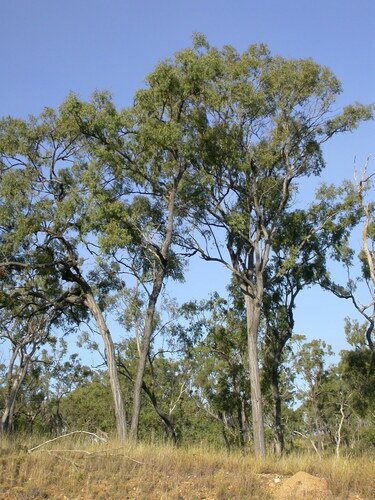
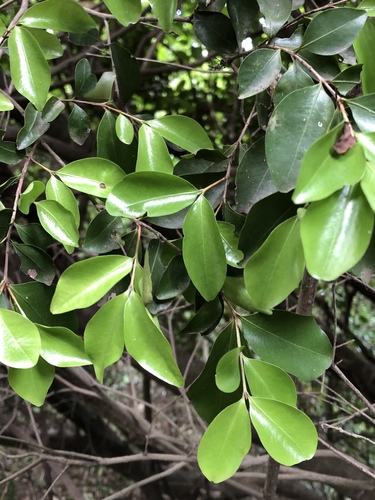
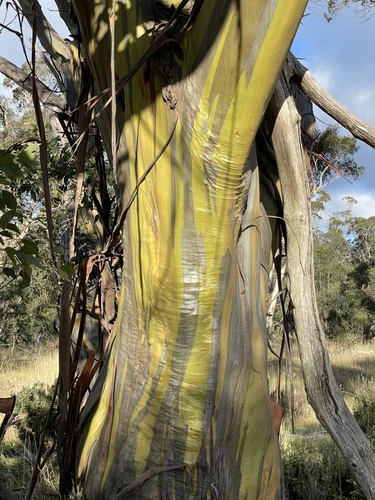
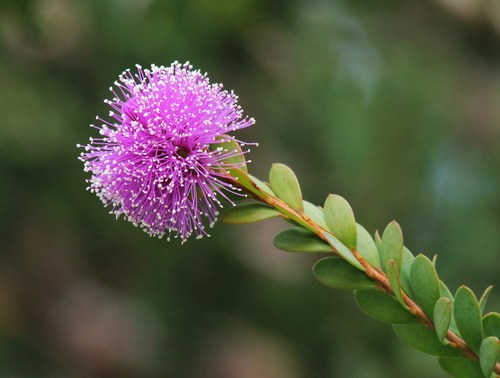
Melaleuca nesophila F.Muell. is a large shrub or small tree that grows 4.7–6 m (15–20 ft) tall and 4–5 m (10–16 ft) wide. It has greyish-white, papery bark and a dense crown that often extends all the way to the ground. Its leaves are arranged alternately, are 11–26 mm (0.4–1 in) long and 4–9 mm (0.2–0.4 in) wide, and are flat, elliptic to narrow egg-shaped with rounded ends. Lavender to rose pink pom-pom-shaped flowers bloom over a long period from spring to mid-summer. The flowers form heads or short spikes at the ends of branches that continue growing after flowering, and sometimes also appear in upper leaf axils. The flower heads can reach up to 30 mm (1 in) in diameter and hold between 2 and 20 groups of three flowers each. The fruit are woody capsules 3–5 mm (0.1–0.2 in) long, arranged in roughly spherical clusters around 20 mm (0.8 in) in diameter. This species occurs in the Gairdner River and East Mount Barren districts, as well as nearby offshore islands, in Western Australia's Esperance Plains biogeographic region. It grows in sand near quartzite rocks, most commonly in dense scrub. Melaleuca nesophila is naturalised in some parts of Victoria, where it is classified as a serious environmental weed because it outcompetes and replaces native indigenous vegetation. In horticulture, Melaleuca nesophila is grown as an ornamental plant by plant nurseries for use in private gardens and drought-tolerant landscaping. It can be planted as a flowering shrub, or trained to grow as a small ornamental tree. It grows well in full sun to part shade, and tolerates both sandy and clay loam soils. Once established, it can withstand extended dry periods and coastal growing conditions.