About Melaleuca brevifolia Turcz.
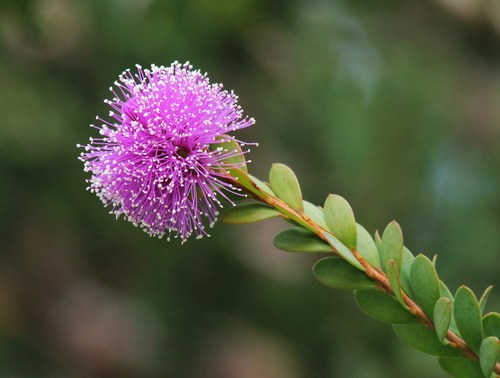
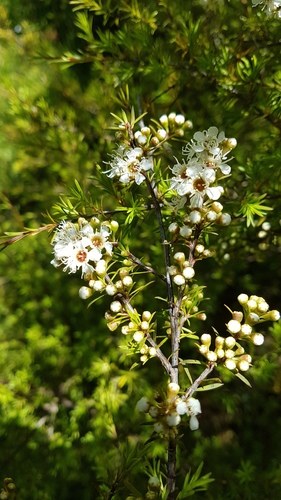
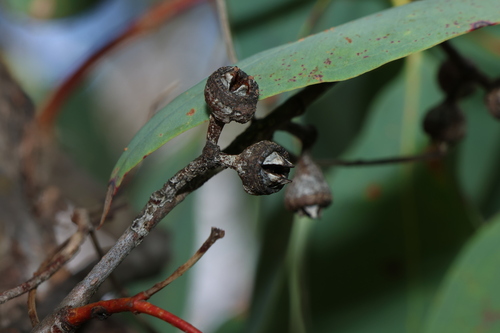
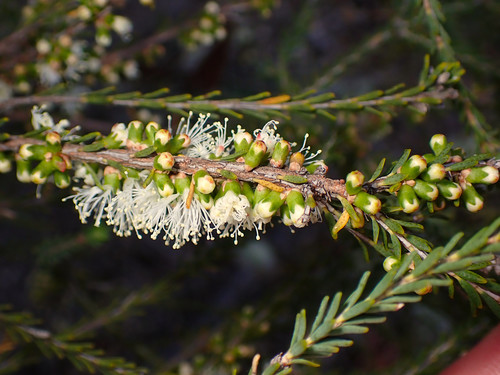
Melaleuca brevifolia Turcz. is most often a shrub, rarely growing as a tree, reaching a height of 4 meters (10 feet). It has rough, corky bark, and its branches and leaves are glabrous except when they are young. Its leaves are arranged in pairs, or sometimes in groups of three. The leaves measure 2.4 to 8 millimeters (0.09 to 0.3 inches) long and 0.7 to 1.5 millimeters (0.03 to 0.06 inches) wide, and are linear to lance-shaped with the narrower end at the base and blunt tips. Two rows of raised oil glands are visible on the lower surface of the leaves. The flowers are white to yellowish, and arranged in heads that grow on growth produced the previous season. Each flower head can be up to 18 millimeters (0.7 inches) in diameter and holds up to six individual flowers. Stamens are arranged in five bundles around each flower, with between 10 and 12 stamens per bundle. The main flowering season for this species is spring. After flowering, it produces wrinkled, cup-shaped capsules that are 3.3 to 4.2 millimeters (0.1 to 0.2 inches) long and wide. This melaleuca occurs in the Mallee, Loddon and Wimmera regions of Victoria, south-eastern South Australia, and the south-west of Western Australia, specifically in the Avon Wheatbelt, Esperance Plains, Geraldton Sandplains, Mallee and Swan Coastal Plain biogeographic regions. It grows in swampy areas and near salt lakes within heathlands and shrublands. In horticulture, Melaleuca brevifolia is a moderately hardy garden plant. It requires good drainage and a full sunny position, and is well suited for harsh growing conditions including salty soils or limestone-containing soils.