About Melaleuca bracteata F.Muell.
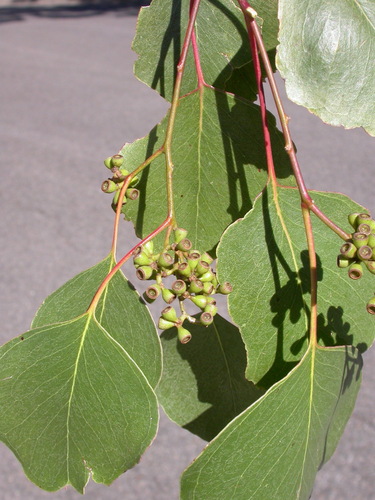
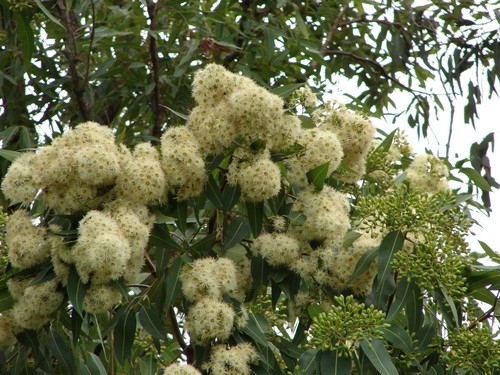
Melaleuca bracteata, commonly known as black tea-tree, is a small to medium tree with dense bushy foliage. It normally grows to a height of 5–8 m (20–30 ft), and may occasionally grow taller. It typically begins flowering and producing seed once it reaches 5–8 m (20–30 ft) in height. This species has rough, dark grey bark. Its leaves are narrow, ranging from lance-shaped to linear, measuring 8–28 mm (0.3–1 in) long by 1–3 mm (0.04–0.1 in) wide. Each leaf has no stalk or only a very short stalk, is arranged spirally around the stem, and grows crowded against adjacent leaves. The upper leaf surface is hairy, particularly when the leaf is young, and has many visible oil-dots. Black tea-tree flowers profusely. Its flowers are loosely grouped into clusters that form cylindrical or ovoid spikes, measuring 30–90 mm (1–4 in) long by approximately 15 mm (0.6 in) across, and are cream or white in colour. Each flower usually has a leaf at its base, and petals are shed shortly after the flower opens. Flowering occurs from spring to early summer. After flowering, the plant produces fruit that is roughly spherical to oval or barrel-shaped, about 3 mm (0.1 in) in diameter, and grows sparsely arranged along the branches. Black tea-tree is distributed in Western Australia, the Northern Territory, and along Australia’s eastern coast from north-east Queensland south to the Macleay River in New South Wales. Disjunct populations also exist in South Australia. It grows in both coastal and inland areas, along stream banks and in wet sites. In New South Wales, it has been recorded in the Northern Tablelands, North Coast and North West Slopes biogeographic regions. In Western Australia, it grows in the Kimberley, Carnarvon and Pilbara biogeographic regions. Indigenous people in the Northern Territory have used this species in smoking medicine, and to make a wide range of household items.