About Megoura viciae Buckton, 1876
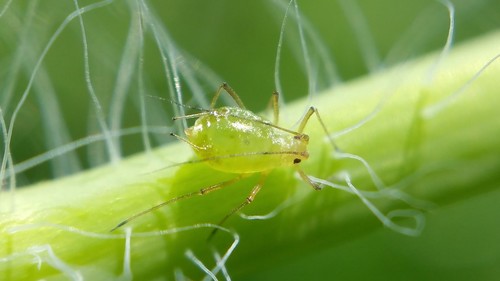
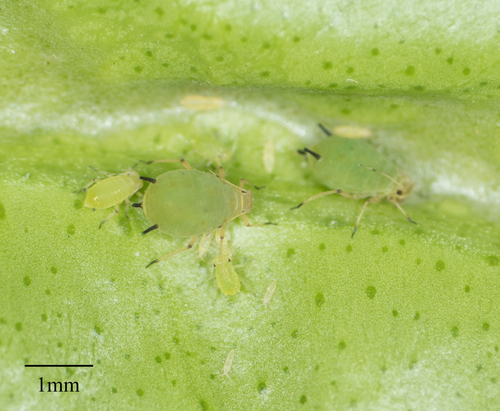
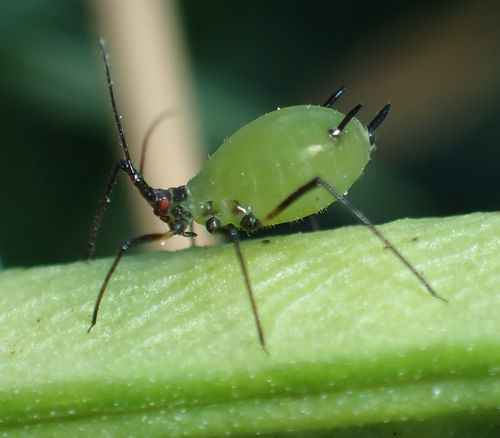
Morphology Megoura viciae, the species covered here, has a large, globular green abdomen paired with a smaller black prothorax. It also has a black cauda, black legs, black antennae, and a black head. Large, crescent-shaped black sclerites are located toward the rear of the body, positioned in front of the siphunculi. Its eyes are red in colour. Depending on the individual’s current life cycle stage, M. viciae may be either winged or wingless.
Distribution and habitat This species is widely distributed across Europe. Its range extends from 64–65° N latitude across Scandinavia, into Denmark and the rest of Europe (including England), and reaches south as far as the Mediterranean. It is also present in Ethiopia, and has been formally recorded from North America.
Life cycle Unlike some aphid species, M. viciae does not move between different primary and secondary host plants. It completes its entire life cycle on a leguminous host plant. Eggs are laid at the base of the host plant, and these eggs hatch in the spring. Winged forms develop after three generations, and these winged aphids then disperse to other plants. In the autumn, the aphids move to the seed pods of their original host plant. Like most aphid species, M. viciae is viviparous.