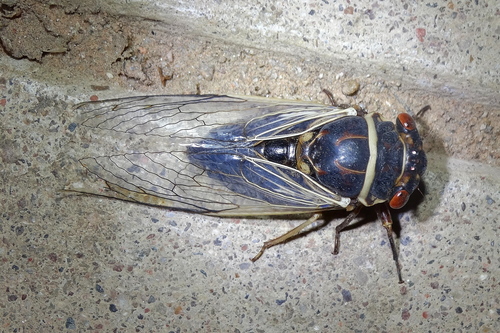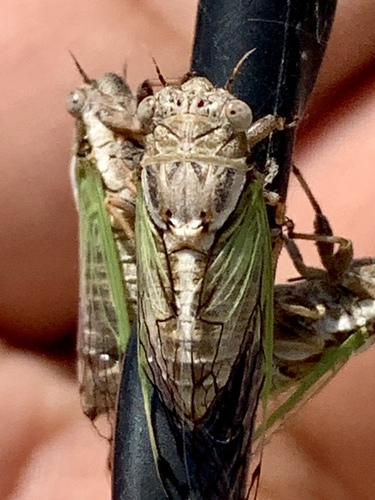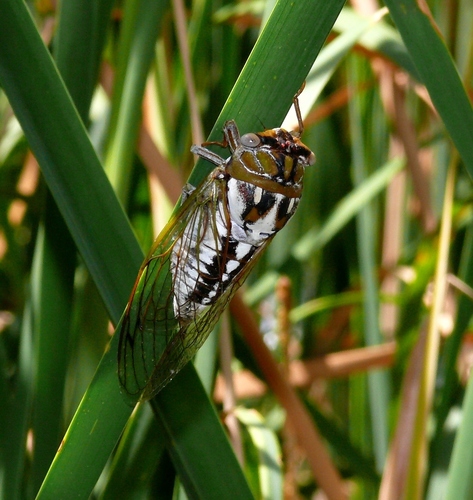
About Megatibicen dealbatus (Davis, 1915)
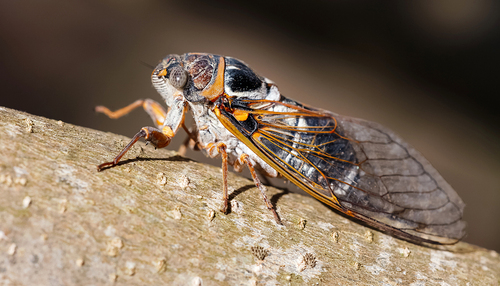
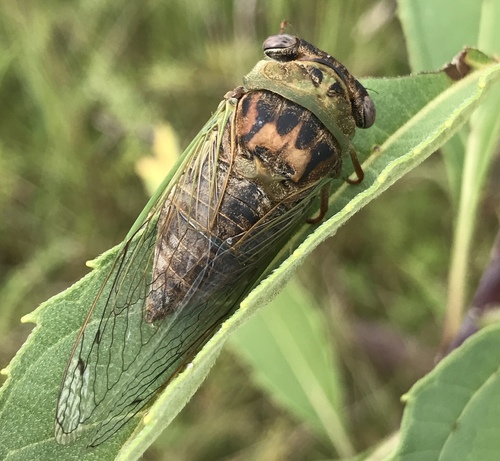
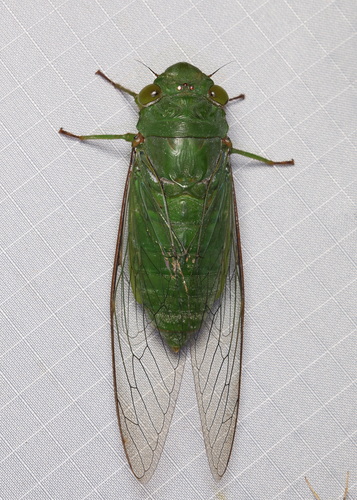
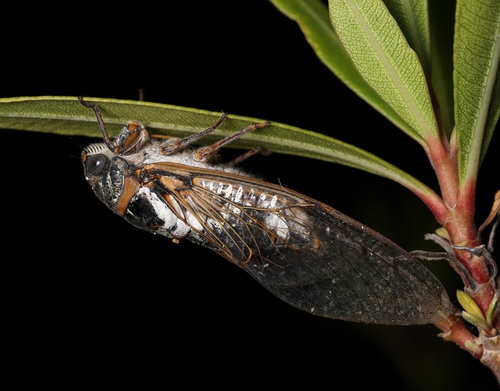
Description and identification: Adult Megatibicen dealbatus have beige-colored eyes. Like many other cicadas in the genus Megatibicen, this species has a distinctive black "mask" that extends from each of its bulging eyes. Its pronotum is light orange or olive green. The mesonotum may be orange, green, black, or brown, with three areas of white pruinosity on the dorsum, separated by stripes. This species is often confused with Megatibicen dorsatus, a superficially similar but distantly related species in the same genus. Both species share overlapping diagnostic traits, including pruinose patterning on the abdomen and a narrow head. This shared set of traits can complicate accurate identification and lead to erroneous reports. However, male calling song, other morphological differences, and the geographic ranges of both species can be used to correctly identify and separate the two.
Distribution: Populations of M. dealbatus are found in central North America, in the U.S. Great Plains region where habitat is favorable. This species occurs east of the Rocky Mountains and west of the Mississippi River, and has been recorded from Colorado, Iowa, Kansas, Montana, Nebraska, New Mexico, North Dakota, Oklahoma, South Dakota, Texas, and Wyoming.
Habitat: M. dealbatus lives in grassland ecosystems, and is most often found in riparian habitats due to the associated trees there. Adult M. dealbatus frequently rest on and use cottonwoods (Populus), willows (Salix), ornamental trees, and nut trees. Nymphs of this species are subterranean, and feed on the roots of trees and other plants.