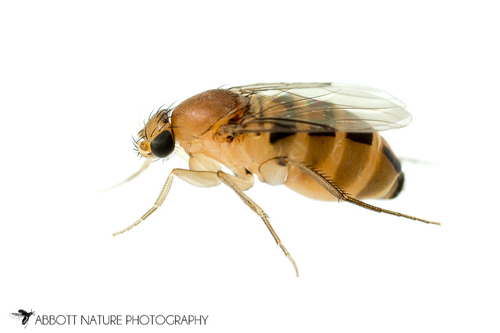
About Megaselia scalaris (Loew, 1866)
Adult Megaselia scalaris are approximately 2 mm long, yellowish with dark markings. The labellum and labrum bear both trichoid and conical sensilla, and the ventral surface of the labellum has five pairs of sharp teeth. The basal half of the hind femur has hairs on its underside, and these hairs are shorter than the hairs in the anteroventral row on the distal half of the femur. The hind tibia does not have a clearly distinct row of spine-like antero-dorsal hairs. This species has a pair of translucent wings, where vein 3 is not wider than the costa, or is barely wider. In male individuals, the labellum is densely covered in microtrichia, the bristles at the tip of the anal tube are longer than the longest hairs on the cerci, and the longest hair on the left side of the epandrium is almost bristle-like. In female individuals, the tergite of the sixth abdominal segment is short, narrow, and shiny, and extends laterally across the segment, which differs from the tergites of the preceding abdominal segments. Larvae of this species are pale, legless, and covered in rows of short spines. The anterior end holds the mouthparts, which resemble a pair of sharp spines and are darker than the surrounding tissue. The posterior end has a pair of spiracles. The optimal culture temperature for Megaselia scalaris is 28 °C. They are common across many areas, and thrive primarily in moist unsanitary locations including dumpsters, trash containers, rotting meat, vegetable remains, public washrooms, homes, and sewer pipes. Although classified as scavengers, adult Megaselia scalaris feed primarily on sugars. Larvae, by contrast, rely on moist decaying plant or animal material, and feed on a wide variety of other decaying materials.

