About Megascops nudipes (Daudin, 1800)
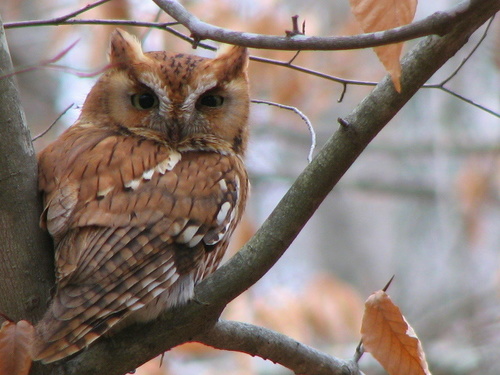
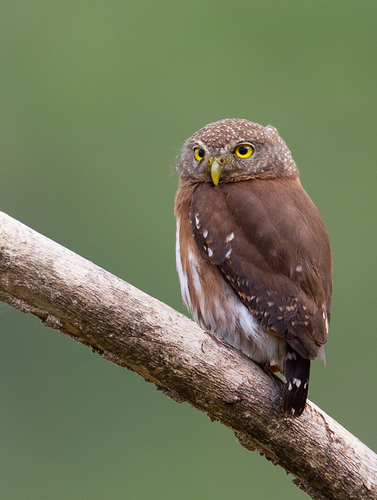
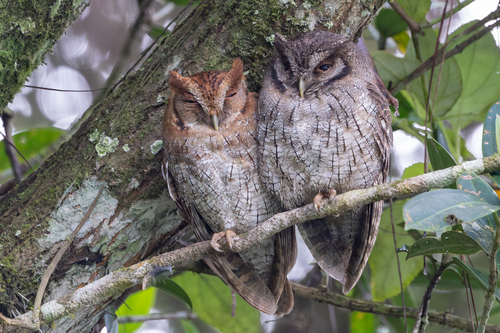
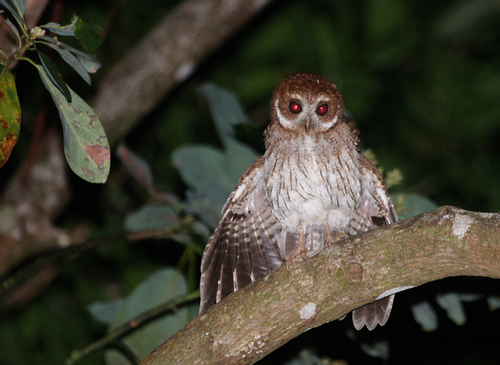
The Puerto Rican owl, scientifically named Megascops nudipes (Daudin, 1800), measures 20 to 25 cm (7.9 to 9.8 in) in length, with a wing length ranging from 154 to 171 mm (6.1 to 6.7 in). It weighs between 100 and 170 g (3.5 to 6.0 oz), and females are slightly heavier than males. It has a rounded head with no ear tufts. This species has three color morphs: the brown morph is the most common, the rufous morph is fairly common, and the gray morph is rare. For the brown morph, the upperparts are brown with irregular paler brown bars and vermiculation. The tail is also brown with paler vermiculation, and the wing coverts have some whitish spots. Its facial discs have narrow alternating light and dark brown bars, while the supercilium and lores are white. Most of the underparts are white, with extensive brown or dusky streaking, barring, and vermiculation. The belly and undertail coverts are usually plain white. Unlike most owls, this species does not have feathered legs, which led to its former common name of Puerto Rican bare-legged owl. Its eyes are brown, the bill is greenish yellow, and the legs and feet range from pale brown to grayish yellow. The rufous morph has pale reddish brown or ochre buff in place of the brown coloration seen in the brown morph. The putative subspecies G. n. newtoni has somewhat paler upperparts and less heavily streaked underparts than the nominate subspecies. The Puerto Rican owl is found across the main island of Puerto Rico. The putative subspecies G. n. newtoni definitely occurred on St. Croix, St. John, and St. Thomas in the Virgin Islands, but has not been positively recorded there since the mid 1800s. It may have occurred on other Virgin Islands, as well as on Vieques and Culebra, but there is no documentation to support these claims. On Puerto Rico, its primary natural habitat is humid lowland forest, but it also lives in dry forest and urban areas. Any small territory with available nest cavities is ideal for this species.