About Megascolia maculata (Drury, 1773)
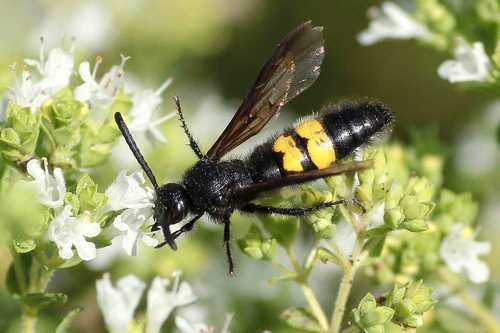
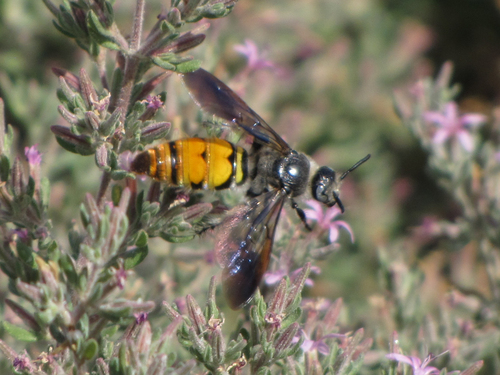
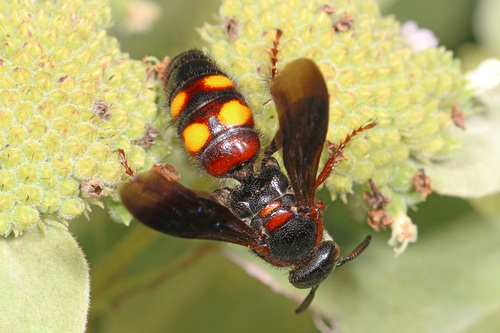
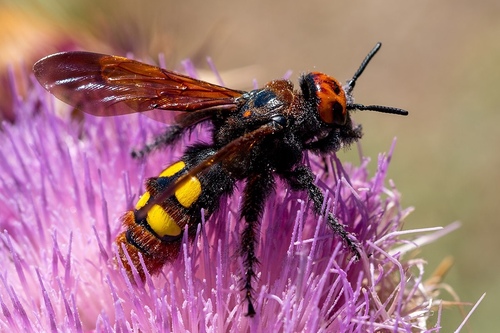
The mammoth wasp (Megascolia maculata) resembles a very large, elongated bumble bee. Females are larger than males, and have a yellow head, while males have a black head. The body is covered in downy hair and is glossy black, with two yellow bands across the abdomen that are sometimes divided to form four yellow spots. Females have shorter antennae than males. Mature females can reach a length of 4.5 cm (1.8 in), with males growing to smaller sizes. This species can be confused with Scolia hirta, but Scolia hirta is smaller and always has a black head. The mammoth wasp is distributed across southern Europe, reaching as far north as Belgium, where it was first recorded in 2018. Its range extends into Russia, North Africa, and the Near East. It has been recorded in southern Great Britain, but it cannot establish a population there because its prey does not occur in Britain. The mammoth wasp inhabits Mediterranean-type habitats including oak forests, maquis, and garrigue. It can only live in areas where its prey, the European rhinoceros beetle Oryctes nasicornis, is also found. In Russia, it is most common around human settlements, where manure piles, sawmills, and compost heaps provide suitable habitat for its prey.