About Megaptera novaeangliae (Borowski, 1781)
Adult humpback whales (Megaptera novaeangliae) are generally 14–15 m (46–49 ft) long, though individuals up to 16–17 m (52–56 ft) have been recorded. Females are typically 1–1.5 m (3 ft 3 in – 4 ft 11 in) longer than males. This species can reach a body mass of 40 metric tons (44 short tons). The longest confirmed recorded lengths are 17.4 m (57 ft) for a male and 18.6 m (61 ft) for a female, though reports of humpback whales measuring 17–18 m (56–59 ft) are considered unlikely. Newborn calves measure around 4.3 m (14 ft) long and weigh 680 kg (1,500 lb).
The species has a bulky body with a thin rostrum and proportionally long flippers, each around one-third of the animal’s body length. It has a short dorsal fin that ranges from nearly non-existent to somewhat long and curved. Like other rorquals, humpback whales have grooves between the tip of the lower jaw and the navel; this species has relatively few grooves, with numbers ranging from 14 to 35. The upper jaw is lined with 540 to 800 total black baleen plates.
The dorsal (upper) side of the humpback whale is generally black, while the ventral (underside) has varying levels of black and white coloration. Humpbacks in the southern hemisphere tend to have more white pigmentation. Flippers can range from all-white to only white on the undersurface. Rarely, individuals may be entirely white, most famously the true albino humpback Migaloo. Unique color patterns and scars on the tail flukes allow individual humpbacks to be distinguished from one another. Females have a distinct round feature called the hemispherical lobe at the end of their genital slit, which can be used to visually distinguish males from females.
Unlike other large whales, humpbacks have bumps called tubercles on their head and the front edge of their flippers, and their tail fluke has a jagged trailing edge. The head tubercles are 5–10 cm (2.0–3.9 in) thick at the base and protrude up to 6.5 cm (2.6 in). They are mostly hollow in the center, and often contain at least one fragile hair that erupts 1–3 cm (0.39–1.18 in) from the skin and is 0.1 mm (0.0039 in) thick. Tubercles develop early in gestation, are rich in nerves, and may have a sensory function. Sensory nerve cells in the humpback’s skin are adapted to withstand the high water pressure of deep dives.
In one study, a humpback whale brain measured 22.4 cm (8.8 in) long, 18 cm (7.1 in) wide at the tips of the temporal lobes, and weighed around 4.6 kg (10 lb). The humpback brain has a complexity similar to the brains of smaller whales and dolphins. Studies of humpback whale brains have identified spindle cells, a type of cell that in humans controls theory of mind. The structure of the humpback eye indicates relatively poor eyesight: the species can only see silhouettes over long distances, and finer details at relatively close range. Computer models of the humpback middle ear suggest the species can hear frequencies between 15 Hz and 3 kHz when stimulated at the tympanic membrane, and between 200 Hz and 9 kHz when stimulated at the thinner region of the tympanic bone adjacent to the tympanic membrane. These hearing ranges match the species’ vocalization ranges.
Like all cetaceans, the humpback whale’s respiratory tract connects to the blowholes and not the mouth, but the species appears able to unlock the epiglottis and larynx and move them toward the oral cavity, allowing it to blow bubbles from its mouth. The humpback’s vocal folds are positioned more horizontally than those of land mammals, which lets the species produce underwater calls. These calls are amplified by a laryngeal sac.
Humpback whales are found in marine waters worldwide, except for some equatorial areas, the High Arctic, and some enclosed seas. The farthest north the species has been recorded is 81°N, near northern Franz Josef Land. Humpbacks are usually coastal and tend to congregate in waters within continental shelves. Their winter breeding grounds are located around the equator, while their summer feeding areas are in colder waters, including near polar ice caps. Humpbacks undertake vast migrations between their feeding and breeding areas, often crossing open ocean, and have been recorded traveling up to 8,000 km (5,000 mi) in a single direction.
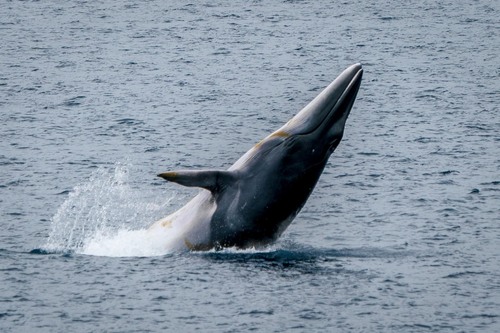
Aside from mother-calf pairs, humpback whale groups typically only stay together for days or weeks at most. They are normally sighted in small groups, though large aggregations form during feeding and when males compete for females. Humpbacks may interact with other cetacean species, including right whales, fin whales, and bottlenose dolphins. Humpbacks are highly active at the surface, performing aerial behaviors such as breaching, lobtailing (surface slapping with the tail fluke), flipper slapping, and peduncle throws, where the tail crashes sideways onto the surface. These behaviors may be forms of play and communication, and may help remove parasites.
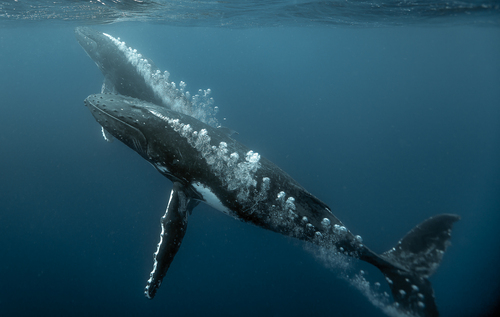
Humpback whales are slower swimmers than other rorquals, cruising at 7.9–15.1 km/h (4.9–9.4 mph). When threatened, they can reach speeds up to 27 km/h (17 mph). Their proportionally long pectoral fins provide great propulsion and allow them to swim in any direction, independent of tail movements. Humpbacks can flap and rotate their flippers in a manner similar to California sea lions. They rest at the surface with their bodies held horizontally. Humpbacks frequent shallow seamounts, commonly explore depths up to 80 meters (260 ft), and occasionally dive as deep as 616 meters (2,021 ft). It is thought these deep dives support navigation, communication with other humpbacks, and feeding activities. Dives typically do not exceed five minutes during the summer, but normally last 15–20 minutes during the winter. As it dives, a humpback typically raises its tail fluke to expose the underside. Humpbacks have been observed producing oral "bubble clouds" when near another individual, possibly in contexts of aggression, mate attraction, or play. They may also use bubble clouds as smoke screens to escape predators.
Mating takes place during the winter months, when females reach estrus and males have peak testosterone and sperm levels. Humpback whales are polygynandrous, meaning both sexes have multiple mating partners. Males frequently trail both lone females and cow-calf pairs; these males are called "escorts". The male closest to the female is the "principal escort", which fights off other suitors called "challengers". Other males, called "secondary escorts", trail farther behind and do not directly participate in conflict. Agonistic behavior between males includes tail slashing, ramming, and head-butting. Male humpbacks have also been observed engaging in copulation with each other.
There is evidence that females may experience pleasure from bubble stimulation, a documented behavior that is novel among cetaceans. Video recorded near Hawaii documents three male humpbacks producing bubbles directly under a female’s genitalia twelve separate times. Instead of fleeing, the female appears to accept these bubbles, exhibiting behaviors including rolling toward the bubbles, arching, or slightly lifting or moving her tail above bubble releases. This behavior has also been documented near the Cook Islands.
Gestation lasts 11.5 months, and females reproduce every two years. Fetuses start out with teeth and develop their baleen during the last months of gestation. Humpback whale births have rarely been observed by humans; one birth witnessed off Madagascar occurred within four minutes. Mothers typically give birth in mid-winter, usually to a single calf. Before birth, a mother will move to shallower coastal water, which reduces her chance of being harassed by escort males. It is common for the mother to help her newborn calf reach the surface. Newborn calves start out with furled dorsal fins, which straighten and stiffen as the calf ages. Calves with furled fins spend more time traveling and surfacing to breathe, while calves with straighter fins can hold their breath longer and can rest and circle at the surface more. Older calves spend more time away from their mothers than younger calves. Calves suckle for up to a year, but can eat adult food by six months of age. Humpbacks reach sexual maturity between 5–15 years of age, depending on the population, and physical maturity is assumed to occur at 8–12 years. They can live for over 50 years; the oldest recorded living humpback whale was 95 years old.