About Meganyctiphanes norvegica (M.Sars, 1857)
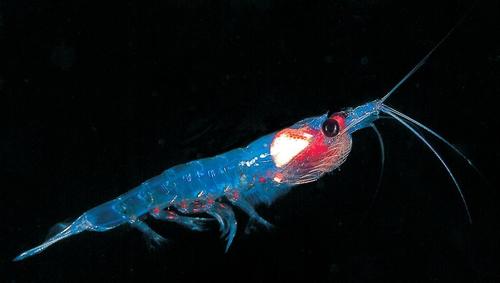
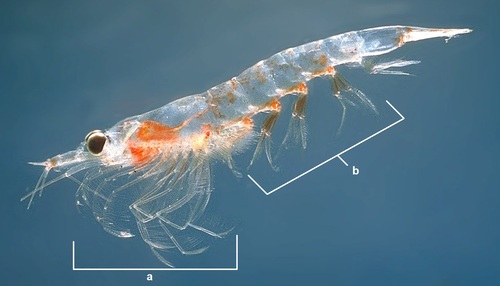
Like all krill species, Meganyctiphanes norvegica, commonly called northern krill, are crustaceans with a transparent chitinous exoskeleton. Adult northern krill reach a maximum length of 4 to 6 centimeters, with an average length of 1.5 to 2 centimeters. As decapods, their body is divided into three main sections: the cephalothorax, the abdomen, and the tail fan. The cephalothorax, which forms the krill's head, holds two antennae and compound eyes. Northern krill use their antennae to sense their surroundings and assist in feeding. Along with antennae, they also have maxillipeds that help move food toward their mandibles, which work alongside maxillipeds to aid in eating. Their compound eyes, a structure also found in insects, let them see over a wide area, detect rapid movement, and navigate deep-sea light conditions. Attached to the cephalothorax is the abdomen, which holds ten swimming appendages arranged as five pairs of forked, non-walking legs called pleopods or swimmerets. Unlike the pleopods of typical decapods, northern krill use their pleopods not just for swimming, but also for grooming and feeding. The tail fan helps northern krill propel themselves forward while swimming. Northern krill reproduce seasonally, with eggs hatching in spring and summer. Their reproduction schedule aligns with their food access: during these months, their phytoplankton food source blooms, providing nutrition for newly hatched larvae. Northern krill exhibit sexual dimorphism, with males and females having distinct reproductive structures. Females are typically smaller, and have a chamber that stores fertilized eggs before release; males have modified pleopods specialized to transfer sperm packets called spermatophores to females. Females can release up to 10,000 oviparous eggs at a time. Females hold their eggs externally before releasing them near the water surface. After release, the eggs sink before hatching into free-swimming nauplius larvae.